
Policy
NYC Issued 111,509 HPD Lead-Paint Violations in Five Years. The Bronx Carried the Map.
NYC HPD issued 111,509 lead-paint and lead-related housing violations Jan 2018 to March 2023. Bronx hit 73 per 1,000 units. Local Law 1 enforcement data.

Key Finding
NYC's Department of Housing Preservation and Development issued 111,509 lead-paint and lead-related housing violations between January 2018 and March 2023. The monthly count climbed from 1,181 in January 2018 to 2,838 in March 2023. The Bronx led every borough at 73 violations per 1,000 residential units. Between 2006 and March 2023, 3,714 building owners faced lead-related housing-court cases citywide. Local Law 1 of 2004 makes the landlord responsible. The map shows which landlords haven't fixed it.
Key Facts
NYC HPD issued 111,509 lead-paint and lead-related housing violations between January 2018 and March 2023. Monthly violations rose from 1,181 to 2,838 across that window.
The Bronx led every borough at 73 lead-related housing violations per 1,000 residential units. It also led in housing-court lead litigation.
Between 2006 and March 2023, 3,714 NYC building owners faced lead-related housing-court cases citywide. Bronx Council District 14 alone accounted for 564 of them.
Local Law 1 of 2004, codified at NYC Administrative Code Section 27-2056, makes the landlord responsible for lead-paint hazards in any apartment with a child under six.
NYC’s Department of Housing Preservation and Development issued 111,509 lead-paint and lead-related housing violations between January 2018 and March 2023. That’s the count from the City Council’s Lead Data Dashboard, the public-records aggregation of every Class C lead hazard HPD has cited under Local Law 1 of 2004. The monthly violation count climbed from 1,181 in January 2018 to 2,838 in March 2023, a 140% increase across five years.
111,509
HPD lead-paint and lead-related housing violations issued by NYC between January 2018 and March 2023. Monthly count climbed from 1,181 to 2,838 across that window.
Methodology
The HPD violation totals here come from the NYC Council Lead Data Dashboard, the City Council’s public-records aggregation of HPD’s Housing Maintenance Code violations classified as lead-paint or lead-related hazards. The dashboard covers January 2018 through March 2023. Sample frame: every HPD-issued Class C (immediately hazardous) lead violation tagged to a Building Identification Number citywide.
The borough-rate figure of 73 violations per 1,000 residential units reflects the Bronx aggregate across the same window. Housing-court litigation counts cover January 2006 through March 2023, scoped to lead-paint-related HP actions filed in NYC Housing Court.
Note
HPD violations are issued only after a complaint or inspection trigger, so the totals understate the actual prevalence of lead-paint hazards in pre-1960 housing. Because enforcement is complaint-driven, hazards in apartments where no tenant calls 311 go uncounted.
The Bronx Carries the Lead-Paint Map
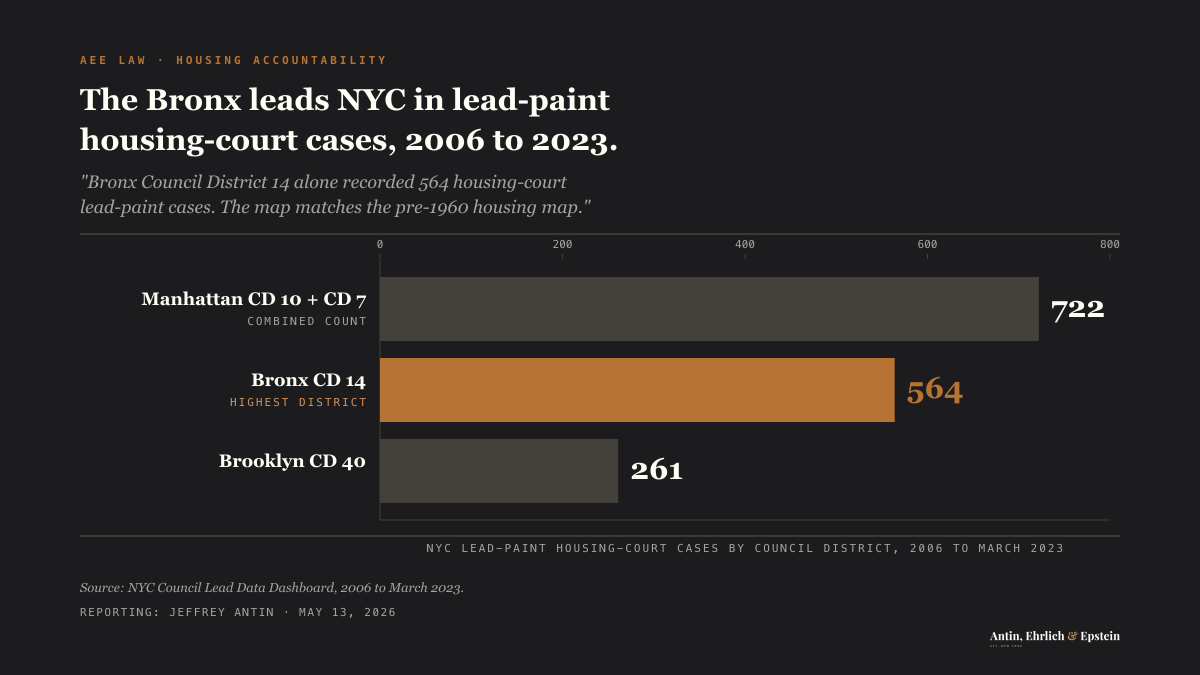
The Bronx leads every borough in lead-paint enforcement metrics. The NYC Council Lead Data Dashboard reports 73 lead-related housing violations per 1,000 residential units in the Bronx, the highest rate citywide. Council District 14, which covers parts of Fordham, Bedford Park, and University Heights, recorded 564 housing-court lead-paint cases between 2006 and March 2023. That’s the highest single-district count in the city.
The Bronx leads because its housing stock leads. Roughly two-thirds of Bronx residential units predate 1960, and Local Law 1 of 2004 establishes a presumption of lead-based paint in any NYC dwelling built before 1960. That presumption shifts the burden onto the owner. If the unit has a child under six, the owner must annually inspect, must remediate any peeling or deteriorated paint within 21 days of notice, and must use EPA-certified abatement workers. Failure to comply is not a paperwork problem. It triggers a Class C immediately hazardous HPD violation, carries city civil penalties of up to $1,500 per violation, and becomes powerful evidence of the landlord’s notice and breach if a child is later diagnosed with elevated blood lead.
The borough with the most pre-1960 housing carries the most lead. The law tells the landlord which years count.
The map looks identical to the Section 1983 map and the construction-fatality map and the asthma-hospitalization map. The same housing stock, the same families, the same enforcement gap. Lead-paint violations aren’t an outlier dataset. They’re another readout of the same underlying problem.
Monthly Violations Climbed 140% in Five Years
In January 2018, HPD issued 1,181 lead-paint violations citywide. In March 2023, the count was 2,838. The growth wasn’t linear. It accelerated after Local Law 66 of 2019 strengthened inspection requirements and lowered the actionable lead-dust threshold. The violation curve is a function of enforcement intensity layered over a steady underlying hazard inventory.
The cumulative count across the five-year window: 111,509 lead-paint and lead-related housing violations. Each one represents a documented hazard in a specific apartment with a specific address tied to a specific landlord. None of that data is hypothetical. HPD recorded every one of those violations, served notice on every owner, and tracks compliance through its own enforcement portal.
What the violation count doesn’t capture: the apartments HPD never inspected. Local Law 1 inspection is complaint-driven. If a tenant doesn’t call 311, doesn’t know the building was built before 1960, doesn’t know there’s a child under six in the apartment next door, the hazard sits. The 111,509 number is the floor, not the ceiling.
The Court Docket Names the Landlords
Between 2006 and March 2023, 3,714 NYC building owners appeared in housing-court lead-paint cases. The Council’s dashboard tracks these by Council District. Bronx Council District 14 led at 564 cases. Manhattan Council Districts 10 and 7 combined for 722 cases. Brooklyn ’s Council District 40 recorded 261.
The peak year was 2008, when 975 lead-paint housing-court cases were filed citywide. The count fell to 29 by March 2023. The decline reflects the rise of administrative enforcement (HPD violations issued without filing in court) rather than fewer hazards. HPD moved most of its lead-paint enforcement out of court and into its own administrative pipeline, which closes faster but generates less public docketing.
For people injured by lead exposure, the court docket is still the venue. A claim against a NYC landlord for lead-paint poisoning in a child runs under three statutes braided together: NYC Administrative Code Section 27-2056 (the Local Law 1 of 2004 framework), New York State Public Health Law Article 13 Title 10 (Lead Poisoning Prevention and Control), and common-law premises liability. Local Law 1 establishes the duty. Public Health Law sets the state-level reporting trigger when a child’s blood lead reaches 3.5 micrograms per deciliter, the CDC reference value adopted in October 2021. Premises liability supplies the damages framework.
A properly proved lead-paint injury case runs on common-law negligence and premises liability, not on Local Law 1’s penalty scheme, which only funds city fines. The recovery stacks economic damages (medical, future special education, future lost earning capacity) and non-economic damages (pain, suffering, cognitive impairment). The HPD violation history is what proves the landlord’s notice and breach. Landlords settle these cases when the file shows the violation history was already on record.
What the Children Are Carrying
The CDC’s blood lead reference value is 3.5 micrograms per deciliter. That’s not a safety threshold. The CDC’s own guidance states there is no known safe blood lead level in children, and even levels below the reference value can affect brain development, learning, and behavior.
NYC DOHMH reports that blood-lead testing of young children has climbed sharply over the past decade under City Council oversight. The testing gap narrowed. The hazard-remediation gap has not.
When a child’s blood test crosses the reference value, the public-health response is well-defined: NYC DOHMH refers the case to HPD for an environmental inspection of the home. If lead paint is found, the owner must remediate. If the owner doesn’t, HPD escalates to a Class C violation and, in some cases, emergency repair. The legal-liability response is also well-defined, but slower. The civil-damages clock starts when the child is harmed.
For a NYC family whose child’s blood test comes back elevated, the next 90 days are the highest-stakes window in the entire claim. HPD inspection records, DOHMH home-environment reports, and the landlord’s prior violation history all become discoverable. Filing within that window preserves the evidence chain that links the apartment’s lead-paint condition to the child’s exposure.
What This Means for NYC Families
If your child is diagnosed with an elevated blood lead level in NYC, three points the data above changes:
The landlord’s prior-violation record is public. HPD violation history, housing-court filings, and NYC Open Data lead-hazard registries are all retrievable by address. A landlord with prior open lead violations on the building has on-record notice of the hazard. That notice element drives the negligence analysis.
The violation record carries legal weight. NYC Administrative Code Section 27-2056 imposes affirmative inspection and remediation duties on the landlord, and an open Class C violation is documented proof the landlord knew and failed to act. That notice element drives the damages a child can recover under common-law negligence.
The two statutory tracks are parallel, not alternative. A claim runs simultaneously under Local Law 1 (the city framework) and NY Public Health Law Article 13 Title 10 (the state framework) plus common-law premises liability. The three tracks read evidence the same way: did the landlord know, did the landlord fix it, and did a child get harmed.
Lead poisoning isn’t an accident. It’s an open violation that didn’t get closed.
Sources
- NYC Council. (2023). NYC Council Lead Data Dashboard, 2018 to March 2023. https://council.nyc.gov/data/lead/
- NYC Department of Housing Preservation and Development. (2004). Local Law 1 of 2004, Childhood Lead Poisoning Prevention Act, codified at NYC Administrative Code Section 27-2056. https://www.nyc.gov/site/hpd/services-and-information/lead-based-paint.page
- CDC. (2021). Blood Lead Reference Value, 3.5 micrograms per deciliter. https://www.cdc.gov/lead-prevention/php/data/index.html
- NY State Senate. (2024). Public Health Law Article 13 Title 10, Lead Poisoning Prevention and Control. https://www.nysenate.gov/legislation/laws/PBH/A13T10
- NYC Open Data. (2024). Housing Maintenance Code Violations Open Data. https://data.cityofnewyork.us/Housing-Development/Housing-Maintenance-Code-Violations/wvxf-dwi5
Updated June 14, 2026
Frequently asked questions
- How many HPD lead-paint violations did NYC issue between 2018 and 2023?
NYC HPD issued 111,509 lead-paint and lead-related housing violations between January 2018 and March 2023, according to the NYC Council Lead Data Dashboard. The monthly count climbed from 1,181 violations in January 2018 to 2,838 in March 2023. Local Law 1 of 2004, codified at NYC Administrative Code Section 27-2056, makes the landlord legally responsible for inspecting and remediating lead-paint hazards in any unit occupied by a child under six.
- Which NYC borough has the most HPD lead-paint violations?
The Bronx leads every borough at 73 lead-related housing violations per 1,000 residential units, according to the NYC Council Lead Data Dashboard. The Bronx also leads in housing-court lead litigation, with 564 cases concentrated in Council District 14 alone between 2006 and March 2023. The borough's older housing stock and concentration of pre-1960 buildings drive both the violation rate and the litigation volume.
- What is Local Law 1 of 2004?
Local Law 1 of 2004, also known as the Childhood Lead Poisoning Prevention Act, is codified at NYC Administrative Code Section 27-2056. It requires building owners to investigate and remediate lead-paint hazards in any apartment occupied by a child under age six. It establishes a presumption of lead-based paint in any pre-1960 NYC building, requires annual visual inspections, and exposes non-compliant owners to Class C immediately hazardous violations and city civil penalties of up to $1,500 per violation. The NY State analog is Public Health Law Article 13 Title 10.
- What is the CDC's blood lead reference value for children?
The CDC's current blood lead reference value is 3.5 micrograms per deciliter, set in October 2021. The CDC states there is no known safe blood lead level in children. Any exposure can harm brain development, learning, and behavior. NYC DOHMH uses 3.5 micrograms per deciliter as the trigger for case management and home inspection referral to HPD.
- What is the new lead paint law in NY?
NYC's Local Law 1 of 2004 (NYC Admin. Code § 27-2056) remains the foundational rule requiring landlords to inspect and remediate lead-based paint hazards in apartments where a child under six resides, and Local Law 66 of 2019 expanded those duties by lowering the actionable lead-dust threshold and requiring annual inspections in pre-1960 buildings. HPD enforces the rules and can issue Class C violations. The City Council's Lead Data Dashboard tracked 111,509 lead-paint and lead-related housing violations between January 2018 and March 2023, with the Bronx leading every borough at 73 violations per 1,000 residential units. Claims involving minors are governed by the tolling provisions in CPLR § 208, so the filing clock works differently than for adults.
- What is the average settlement for lead poisoning?
Settlement values for childhood lead poisoning cases in NYC vary widely depending on the child's blood lead level, the degree of documented neurological or developmental harm, the age at exposure, and whether the landlord had prior notice. Cases with severe cognitive impairment, learning disabilities, or behavioral disorders documented through neuropsychological testing tend to produce higher recoveries than cases with lower lead levels and limited documented injury. Under Local Law 1 of 2004 (NYC Admin. Code § 27-2056), landlords have affirmative duties to remediate in pre-1960 buildings where children under six reside, and a documented prior violation history strengthens the negligence claim by proving the landlord's notice and failure to act. HPD violation records on NYC Open Data are critical evidence of notice and failure to act.
- Do all houses built before 1978 have lead paint?
Not every pre-1978 home contains lead paint, but New York City law treats the age threshold as a serious risk indicator. Under Local Law 1 of 2004 (NYC Admin. Code § 27-2056), landlords in buildings built before 1960 face a legal presumption that lead-based paint is present, while buildings between 1960 and 1978 trigger the same investigation duties only when the owner has actual knowledge that lead-based paint is present and a child under six resides there. HPD uses inspection and XRF testing to confirm actual conditions rather than relying on construction date alone. A pre-1978 building that was fully remediated and certified under HPD protocols may no longer present the same hazard, though documentation of that remediation matters in any legal dispute. The specific construction date, inspection history, and violation record are all facts a trial lawyer will want to examine.
- What year was lead paint banned in NYC?
The federal government banned lead-based paint in residential housing in 1978. New York City had already restricted lead in residential paint earlier under local health regulations, but the federal ban set the bright line still used today. Local Law 1 of 2004 (NYC Admin. Code § 27-2056) establishes a presumption of lead-based paint in any NYC dwelling built before 1960, where lead-paint use was heaviest. For buildings constructed between 1960 and 1978, the owner's investigation and remediation duties apply only when the owner has actual knowledge that lead-based paint is present and a child under six resides in the unit. HPD violation records back to 2018 are publicly searchable on the City Council's Lead Data Dashboard.
Injured in NYC? Talk to a Trial Lawyer.
Free consultation. No fee unless we win.
For journalists, researchers, and re-publishers
Use this insight
Cite this insight
Three formats. Click to copy. Use whichever your style guide accepts.
APA AP style BibTeX
Antin, J. S. (2026, May 13). NYC Issued 111,509 HPD Lead-Paint Violations in Five Years. The Bronx Carried the Map.. AEE Law Insights. https://aeelaw.com/insights/nyc-lead-paint-landlord-hpd-pattern/
Contact the data desk
AEE Law editorial desk. Press inquiries answered within one business day.
Contact the data desk
If you were injured in New York and need a lawyer, get Jeff's read on your case.
More from AEE Law Insights
NYC Parking Lot and Garage Collapses, A 2025-2026 Risk Map the City Already Has
NYC's first Local Law 126 inspection cycle flagged 110 of 550 categorized parking structures as unsafe, roughly one in five. The 1925-built structure at 57 Ann Street had 64 DOB violations on record before it collapsed in April 2023. The Department of Buildings closed one garage outright and fined about 400 owners for missing the Sub-Cycle 1A deadline, where only 62% of garages complied. Brooklyn and the rest of Manhattan are filing now. Bronx, Queens, and Staten Island file by December 31, 2027.
NYC Logged 34,033 Dog Bite Reports Across a Decade. The Law Is Two Laws.
NYC's Department of Health and Mental Hygiene logged 34,033 reportable dog bites between 2015 and 2024, including 4,041 in 2024 alone, the highest annual count in the decade. Queens led every borough with 8,652 reports. Pit Bull was the top named breed at 5,853 bites. New York liability runs on a hybrid framework: NY Agriculture and Markets Law § 123 imposes strict liability for medical and veterinary costs when a dog is judicially adjudicated dangerous, while general dog bite damages ride on the common-law vicious propensity rule set in Bard v. Jahnke and Collier v. Zambito. As of April 2025, Flanders v. Goodfellow also lets a bite victim sue in ordinary negligence, not just on the vicious propensity rule.
NYC Slip-and-Fall Verdicts: From a $6.45M Fish-Guts Case to a $32M Hotel Door
NYC slip-and-fall verdicts in 2024 and 2025 ranged from a $6.45 million slip on fish guts outside an Upper West Side grocery store to a $32.1 million jury award against a Midtown Hilton Garden Inn after a broken bathroom door fell on a guest. Most of that Hilton award was punitive, and the court later cut the punitive portion from $30 million to $10 million. The cases share a structural pattern: actual or constructive notice of a hazard, a failure to remedy it, and a plaintiff with documented serious injuries. The cases that succeed tend to have a paper trail showing the property owner knew about the danger before it caused the injury.