
Safety Analysis
They Did Everything Right. The Crosswalk Failed Them Anyway.
29% of NYC's seriously injured pedestrians had the walk signal. They crossed with the right of way, and the intersection failed them anyway.

Key Finding
NYC recorded 111 pedestrian deaths in 2025, the lowest on record and down 9% from 122 in 2024. Pedestrian fatalities are down about 40% since the year before Vision Zero began. But wide arterial roads in Brooklyn, Queens, and the Bronx still produce the deadliest crashes.
Key Facts
111 NYC pedestrians killed in 2025, the lowest on record. Down 9% from 122 in 2024 and about 40% from the year before Vision Zero launched.
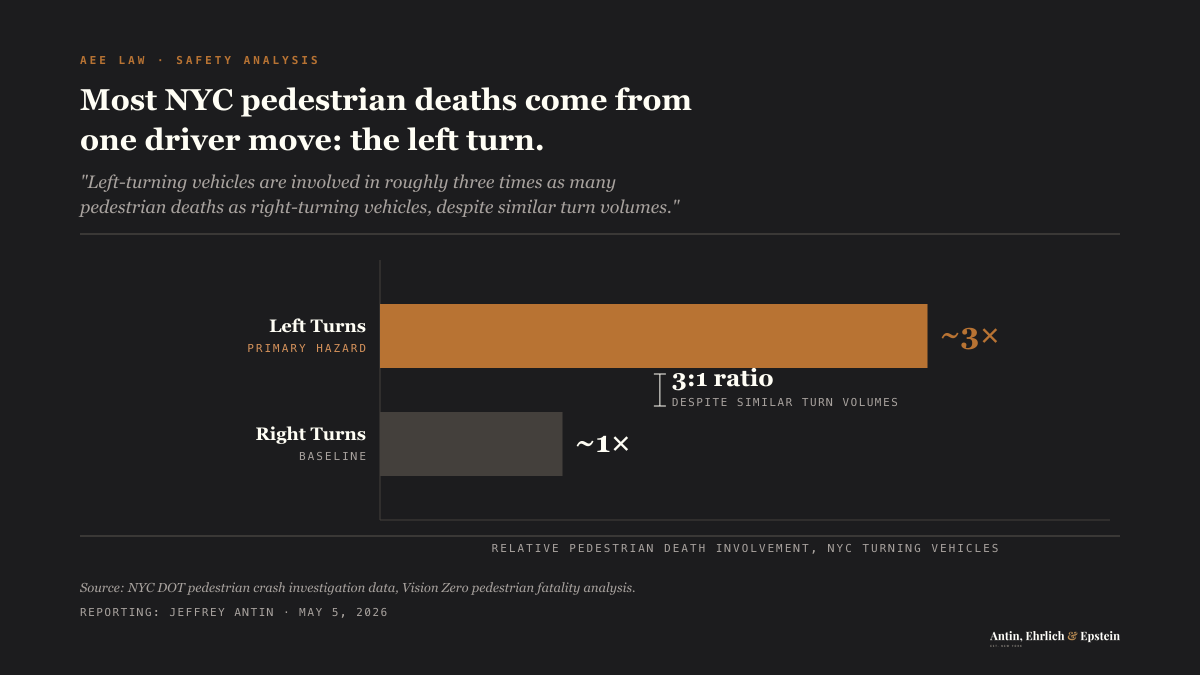
Left-turning vehicles cause roughly 3 in 4 turn-involved NYC pedestrian deaths despite similar left and right turn volumes.
29% of seriously-injured NYC pedestrians were crossing with the signal. They had the right of way and the intersection failed them.
NYC DOT leading-pedestrian intervals cut pedestrian and cyclist deaths and serious injuries 60% at the intersections where they were installed.
New York City recorded 111 pedestrian deaths in 2025, the lowest number on record. That was down 9% from 122 in 2024 and represents about a 40% drop from the 184 pedestrians killed in 2013, the year before Vision Zero launched in 2014.
111
Pedestrians killed in NYC in 2025, the lowest on record. Down 9% from 122 in 2024 and about 40% from the year before Vision Zero launched in 2014. Pedestrian fatalities still account for more than half of all NYC traffic deaths.
The progress is real. But 111 people killed while walking is not zero. Pedestrian fatalities still account for more than half of all NYC traffic deaths. The data shows where the danger persists and which communities bear the greatest risk.
The 2025 Picture
NYC recorded 205 total traffic deaths in 2025, a 19% decline from 253 deaths in 2024. Of those, 111 were pedestrians. The improvements were not spread evenly across the city.
The Bronx saw the largest improvement: a 39% reduction in traffic fatalities from 2024, down from 54 to 33, with 21 fewer deaths.
Queens followed with a 23% reduction from 2024, down from 74 to 57, with 17 fewer deaths.
Brooklyn and Manhattan saw less dramatic reductions.
Staten Island fatalities rose slightly by one.
The overall trend since Vision Zero began in 2014 is clear: a 31% reduction in all traffic deaths. According to Transportation Alternatives’ 2025 year-end analysis, protected bike lanes have reduced deaths and serious injuries for all road users by 18.1% at locations where they’ve been installed.
The Deadliest Roads
Pedestrian fatalities don’t scatter randomly across the city. They concentrate on a specific type of road: wide, multi-lane arterials designed to move cars fast.
Wide Arterial Roads
Roads with four or more travel lanes, speed limits of 30 mph or higher, and long distances between crosswalks produce the most pedestrian deaths. These include:
- Atlantic Avenue(Brooklyn): Six lanes through dense commercial areas
- Northern Boulevard(Queens): Fast-moving traffic through Jackson Heights and Flushing
- Grand Concourse(Bronx): Wide divided boulevard through residential neighborhoods
- Hylan Boulevard( Staten Island): Suburban-speed road with few controlled crossings
Left-Turn Hazards
Vehicles making left turns account for a disproportionate share of pedestrian fatalities. A left-turning driver looks for oncoming traffic, finds a gap, accelerates through the turn, and strikes a pedestrian in the crosswalk they did not look at.
Left-turning vehicles are involved in roughly three times as many pedestrian deaths as right-turning vehicles, despite similar turn volumes. The city responded by adding leading pedestrian intervals. These give walkers a head start before cars get the green light.
Mid-Block Crossings
People struck while crossing mid-block, away from a crosswalk, account for a big share of deaths. But blaming walkers misses the point. Many of these crossings happen on long blocks where the nearest crosswalk is hundreds of feet away. The road design forces people to choose between a long detour and a risky crossing.
How Crashes Happen
NYC DOT’s Severe Injury Response Team Analysis breaks down the mechanics of serious pedestrian injuries:
- 67% of serious pedestrian injuries occurred at intersections
- 25% happened at mid-block locations
- 29% of cases involved pedestrians crossing with the signal, meaning they had the right of way
- 14% involved crossing at unmarked locations or without signals
That 29% figure is significant. Nearly a third of seriously injured pedestrians were doing everything right. The intersection itself failed them.
Who Gets Killed
Pedestrian fatalities in NYC are not evenly distributed across the population.
Older adults (65+) are dramatically overrepresented. Slower walking speeds mean they can’t clear wide crosswalks during signal phases designed for younger, faster walkers. They’re also more likely to suffer fatal injuries from the same impact that a younger person would survive.
Low-income neighborhoods have higher pedestrian death rates than affluent areas. The roads are wider, the infrastructure is older, and the investment in safety improvements has historically been lower.
Nighttime crashes produce a disproportionate share of fatalities. Reduced visibility makes it harder for drivers to see pedestrians. Alcohol impairment, by either party, is a factor in many nighttime pedestrian deaths.
Vision Zero: Progress and Gaps
Mayor de Blasio launched Vision Zero in 2014. The program has achieved meaningful results, but the goal of zero traffic deaths remains distant.
What has worked:
- Speed limit reduction to 25 mph citywide
- Speed cameras in school zones, now expanded to 247 locations
- Leading pedestrian intervals at thousands of intersections
- Over 100 miles of protected bike lanes
- Nearly 2 million square feet of new pedestrian space
Where gaps remain:
- Many of the deadliest arterial corridors have not been redesigned
- Enforcement of failure-to-yield violations has been inconsistent
- Large vehicle blind-spot standards remain inadequate
- Pedestrian signals on wide roads still don’t give enough crossing time
The 60% decrease in pedestrian and cyclist deaths and serious injuries at locations with leading pedestrian intervals shows that targeted infrastructure changes work. Scaling those changes to every dangerous intersection is the challenge.
Legal Rights for Pedestrians Who Are Injured
Pedestrians struck by vehicles in New York have strong legal protections.
The “Serious Injury” Threshold
A pedestrian struck by an insured New York vehicle is a covered person under Insurance Law § 5104(a) , so recovering for pain and suffering still requires meeting the serious injury threshold under Insurance Law § 5102(d). The good news is that pedestrian crashes routinely clear that bar.
A fracture is its own enumerated category, so a broken wrist qualifies on its own. So do significant disfigurement, permanent loss of use, and a significant limitation of a body function or system, all common in pedestrian cases.
Driver Liability Is Often Clear
Drivers have a duty to yield to pedestrians in crosswalks. Failure to yield is a traffic violation and establishes negligence. Even when a pedestrian crosses outside a crosswalk, the driver still has a duty to exercise due care.
City Liability for Dangerous Roads
If a road’s design contributed to the crash, including a lack of crosswalks, inadequate signal timing, or missing pedestrian islands, the City of New York may share liability. These claims require a Notice of Claim within 90 days under General Municipal Law § 50-e.
Higher Case Values
Pedestrian injuries tend to be more severe than car occupant injuries at comparable speeds. A 30 mph impact that causes whiplash in a car can cause a traumatic brain injury, multiple fractures, or death for a pedestrian.
What to Do After a Pedestrian Crash
Call 911. Even if you feel okay, get checked by paramedics. Adrenaline masks pain. Internal injuries may not produce symptoms for hours.
Stay at the scene until police arrive and complete an accident report.
Document everything. Photograph the intersection, traffic signals, crosswalk markings, your injuries, and the vehicle that struck you. Get witness contact information.
Don’t give statements to the driver’s insurance company before speaking with an attorney. They’ll try to establish that you were at fault.
Act quickly on government claims. If road design contributed to your crash, the 90-day Notice of Claim deadline against the city is unforgiving. The personal injury statute of limitations is three years under CPLR § 214(5). Wrongful death claims must be filed within two years under EPTL § 5-4.1.
Note
If the vehicle that struck you was operated by the City of New York or the MTA, a Notice of Claim must be filed within 90 days under General Municipal Law § 50-e. Missing that window bars the claim, even when fault is clear.
Frequently Asked Questions
Can I sue if I was jaywalking when hit by a car?
Often, yes. New York’s comparative negligence rule reduces your recovery by your percentage of fault. For lawsuits filed on or after May 26, 2026, CPLR 1411(b), added by Bill A10008 (Chapter 58 of 2026), bars recovery when your fault is greater than the combined fault of the drivers you sue.
Below that line, partial fault reduces your award without barring the claim.
How much is a pedestrian accident case worth in NYC?
Severity dictates value. A broken leg with surgery is commonly worth $300,000 to $750,000. A traumatic brain injury with permanent effects can reach seven figures. Wrongful death cases for pedestrians killed by vehicles commonly produce verdicts and settlements exceeding $5 million.
Which borough has the most pedestrian deaths?
Brooklyn and Queens consistently account for the most pedestrian fatalities. The Bronx has the highest per-capita rate, reflecting wider roads and less pedestrian infrastructure investment.
Sources
- NYC Department of Transportation. (January 2026). Traffic Deaths Reach All-Time Low. https://www.nyc.gov/html/dot/html/pr2026/traffic-deaths-reach-all-time-low.shtml
- Transportation Alternatives. (2025). After 247 Speed Cameras, Safety Projects, and Over a Decade of Vision Zero, Historically Safe 2025 on New York City's Streets. https://transalt.org/press-releases/after-247-speed-cameras-safety-projects-and-over-a-decade-of-vision-zero-historically-safe-2025-on-new-york-citys-streets-demonstrates-the-need-to-double-down-on-what-works
- NYC Department of Transportation. Vision Zero View Interactive Map. https://www.nyc.gov/content/visionzero/pages/data
- NYC Department of Transportation. (2025). Severe Injury Response Team Analysis (SIRTA) Report, Q2 2025. https://www.nyc.gov/html/dot/downloads/pdf/sirta-report-q2-2025.pdf
- Gothamist. (2025). NYC Records Its Lowest Number of Traffic Deaths Ever in 2025. https://gothamist.com/news/nyc-records-its-lowest-number-of-traffic-deaths-ever-in-2025
- NY Senate. (2026). Bill A10008 (Chapter 58 of 2026): CPLR § 1411 Amendment. https://www.nysenate.gov/legislation/bills/2025/A10008
Updated July 23, 2026
Frequently asked questions
- Can I sue if I was jaywalking when hit by a car?
Often, yes. New York's comparative negligence rule reduces your recovery by your percentage of fault. For lawsuits filed on or after May 26, 2026, CPLR 1411(b), added by Bill A10008 (Chapter 58 of 2026), bars recovery when your fault is greater than the combined fault of the drivers you sue. Below that line, partial fault reduces your award without barring the claim.
- How much is a pedestrian accident case worth in NYC?
Severity dictates value. A broken leg with surgery might be worth $300,000 to $750,000. A traumatic brain injury with permanent effects can reach seven figures. Wrongful death cases for pedestrians killed by vehicles commonly produce verdicts and settlements exceeding $5 million.
- Which borough has the most pedestrian deaths?
Brooklyn and Queens consistently account for the most pedestrian fatalities. The Bronx has the highest per-capita rate, reflecting wider roads and less pedestrian infrastructure investment.
- How many pedestrian fatalities are there in NYC each year?
NYC recorded 111 pedestrian deaths in 2025, the lowest annual total on record and down 9% from 122 in 2024. That is about a 40% drop from the 184 pedestrians killed in 2013, the year before Vision Zero launched. Pedestrian fatalities still account for more than half of all NYC traffic deaths, with corridors in Brooklyn and Queens producing a disproportionate share of the city's serious-injury and fatal crashes. When a pedestrian is killed, surviving family members may have a wrongful death claim under EPTL § 5-4.1, and liability claims against a driver run through Insurance Law § 5102 and VTL § 388. If a city-owned vehicle or a dangerous roadway defect contributed, GML § 50-e generally requires a notice of claim within 90 days.
- What type of vehicle kills the most pedestrians?
Large trucks and SUVs cause a disproportionate share of pedestrian fatalities in NYC. Taller, heavier vehicles with higher front-end profiles tend to strike pedestrians in the torso or head rather than the legs, which makes catastrophic or fatal injury much more likely. NYC Open Data and NYC DOT Vision Zero reports flag commercial trucks, box trucks, and delivery vehicles as overrepresented in fatal crashes along high-volume Brooklyn and Queens corridors. Liability often extends past the driver: VTL § 388 reaches the vehicle owner, and federal FMCSA regulations can pull in the motor carrier or employer when an interstate truck is involved.
- Is NYC safe for pedestrians and cyclists?
NYC has made real progress under Vision Zero, with 2025's 111 pedestrian deaths the lowest annual total on record. The data still shows clear danger zones: NYC DOT and NYC Open Data consistently flag outer-borough arterials like Atlantic Avenue, Queens Boulevard, and Flatbush Avenue as the corridors producing most of the city's serious-injury and fatal crashes. Left-turning vehicles cause roughly three out of four turn-related pedestrian deaths despite similar left and right turn volumes. When someone is struck, Insurance Law § 5102 no-fault benefits cover initial medical costs, but recovering for pain, suffering, and lost wages above the threshold usually requires a separate liability claim.
- What are 90% of accidents caused by?
Human error accounts for the overwhelming majority of motor vehicle crashes, with the NHTSA attributing roughly 94 percent of serious crashes to driver-related factors such as distraction, fatigue, speeding, and impaired judgment. In the context of Amazon delivery truck crashes, this figure carries particular weight because the DSP (Delivery Service Partner) contractor model can create pressure on drivers to complete high-volume routes within tight windows, which contributes to the kinds of fatigued and distracted driving NHTSA identifies as primary crash causes. Under New York's Vehicle and Traffic Law § 388, an owner of a vehicle, including a commercial fleet operator or contractor, can be held liable when a driver operates that vehicle with permission and causes injury through negligent conduct. FMCSA records and safety data are often central to establishing whether a commercial carrier maintained adequate hiring, training, and supervision practices before a crash occurred. If you or someone you know was injured in a delivery truck collision in New York City, an attorney can review the full chain of responsibility, including the DSP contractor, the logistics company, and any parent corporation that may share liability.
Injured in NYC? Talk to a Trial Lawyer.
Free consultation. No fee unless we win.
For journalists, researchers, and re-publishers
Use this insight
Cite this insight
Three formats. Click to copy. Use whichever your style guide accepts.
APA AP style BibTeX
Antin, J. S. (2026, February 14). They Did Everything Right. The Crosswalk Failed Them Anyway.. AEE Law Insights. https://aeelaw.com/insights/pedestrian-deaths-nyc/
Contact the data desk
AEE Law editorial desk. Press inquiries answered within one business day.
Contact the data desk
Methodology
Data sources
- NYC DOT annual traffic fatality counts (January 2026 release) covering calendar years 2013 through 2025.
- NYC DOT Vision Zero View interactive crash map for intersection-level kills and serious injuries.
- Transportation Alternatives Vision Zero 2025 Year-End Analysis (turn-direction crash investigation data).
Processing notes
Pedestrian fatality counts pulled from NYC DOT's annual reports, then cross-checked against Vision Zero View intersection records. The 2025 count of 111 deaths reflects citywide NYPD-reported fatal pedestrian collisions. Turn-direction breakdowns come from NYC DOT's pedestrian crash investigation dataset, which covers fatal and serious-injury crashes investigated by Collision Investigation Squad. Time window: 2013 baseline (year before Vision Zero) through end of 2025.
Limitations
- Counts exclude pedestrians killed on private property, parking lots, and driveways not in the NYPD motor vehicle collision dataset.
- Hit-and-run pedestrian deaths where the involved vehicle was never identified can be undercounted in turn-direction analysis.
- Borough-level totals shift when NYPD reclassifies cases between motor vehicle and non-traffic categories.
Peer review
Internal review by Jeffrey Antin. Source data is from NYC DOT and Transportation Alternatives published reports.
Last updated
2026-05-11
If you were injured in New York and need a lawyer, get Jeff's read on your case.
More from AEE Law Insights
Five Years Later, New York's Traffic Deaths Are Still 18% Above 2019
New York recorded 1,101 traffic deaths in 2024, 17.9% more than the 934 recorded in 2019, the state's pre-pandemic low. Deaths peaked at 1,182 in 2022 and have eased since, but they remain well above where they stood before the pandemic. The decade of steady declines that ran through 2019 has not resumed.

New York's Deadliest Roads Aren't in the City. They're Upstate.
From 2019 to 2023, Genesee County recorded 51 traffic deaths against a population near 58,000, a rate of 88 per 100,000 residents over those five years. Manhattan's five-year rate was 11.5. Genesee's was 7.6 times higher. Thirty counties, nearly all of them rural and upstate, were deadlier per person than any New York City borough, even though the city recorded far more crashes overall.
The NYC E-Bike Injury Ledger: Every Crash, Every Person Hurt
New York's e-bike-involved crashes have injured 17,434 people and killed 133 since 2019, pedestrians and delivery riders alike. This ledger comes from a full review of 2.27 million NYPD collision records, counting e-bike crashes through May 2026. In 2025, eight of the city's 23 cyclist deaths happened in e-bike-involved crashes.