
Safety Analysis
73% of Fatal NY Construction Sites Had OSHA Violations Tied to the Death. The Wage-Theft File Describes the Same Low-Road Economy
NYCOSH 2025: in 73% of OSHA-investigated NY construction deaths in 2023, employers had violations tied to the death. Comptroller recovered $15M+ in back pay.

Key Finding
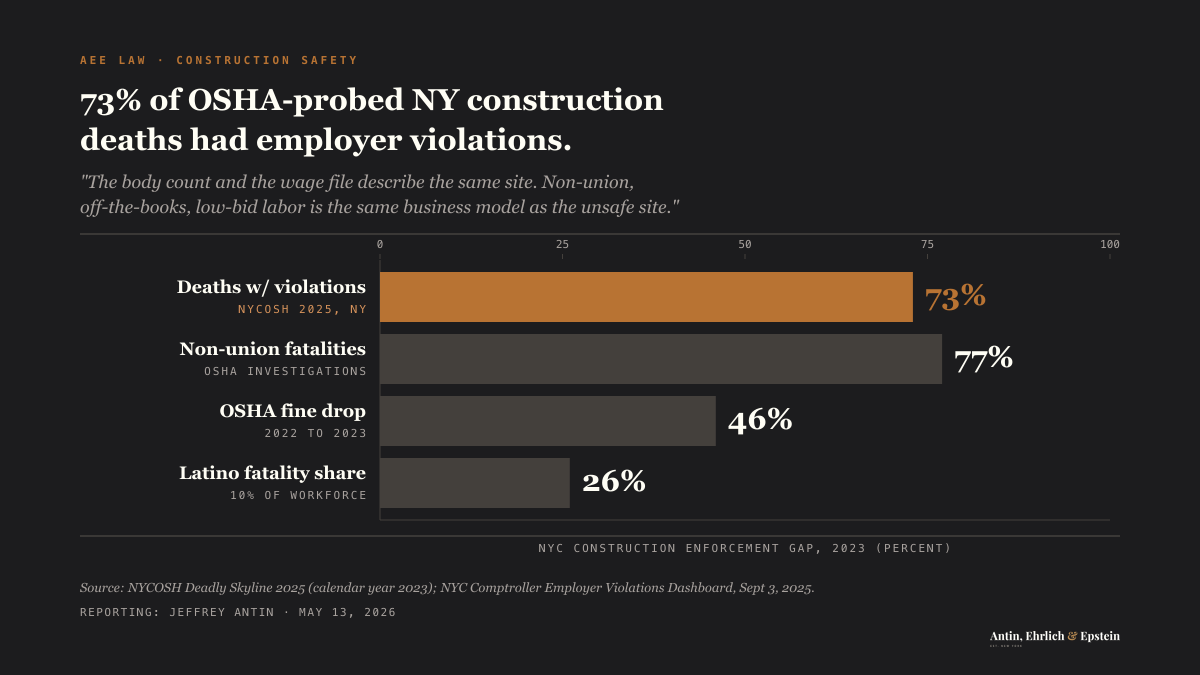
NYCOSH's 2025 Deadly Skyline report found that in 73% of the 44 OSHA-investigated New York construction deaths in 2023, employers had OSHA violations tied to the fatal incident. 77% of those fatalities happened on non-union sites. In the same window, the NYC Comptroller has recovered over $15 million in back wages from contractors on public projects, and the September 2025 Wall of Shame named contractors with both wage and safety records: Montis Construction (prevailing wage, debarred) and NY Developers & Management (32 OATH-adjudicated construction safety violations, $73,000 in fines). These are two different firms, but the pattern is the same. Low-bid, non-union, off-the-books labor is the same business model as the unsafe job site.
Key Facts
In 73% of the 44 OSHA-investigated New York construction deaths in 2023, employers had OSHA violations tied to the fatal incident. 30 of those deaths happened in NYC, the highest single-year toll in over a decade.
77% of fatal construction sites investigated by OSHA in 2023 were non-union. Latino workers were 10% of the workforce but 26% of the fatalities.
Average OSHA fine for a fatal construction case dropped 45.6%, from $59,075 in 2022 to $32,123 in 2023. NYC Department of Buildings’ fiscal 2025 headcount plan ran 119 positions below 2024.
NYC Comptroller has recovered over $15 million in back wages since January 2022. The September 2025 Wall of Shame named Montis Construction (debarred, prevailing wage) and NY Developers & Management (32 OATH safety violations).
In 73% of the OSHA-investigated New York construction deaths in 2023, employers had OSHA violations tied to the fatal incident. That’s a headline number from NYCOSH’s 2025 Deadly Skyline report, drawn from OSHA’s 44 fatality investigations that year.
NYC carried 30 of those deaths, the highest single-year toll in over a decade. The same year, NYC’s Comptroller crossed $15 million in recovered back wages from contractors who shorted workers on public projects. The two enforcement files describe a single business model.
73%
of the 44 OSHA-investigated New York construction deaths in 2023 had OSHA violations tied to the fatal incident. 77% were non-union. The Comptroller has recovered over $15M in back wages from the same kind of low-bid public-works contractors since January 2022.
NYCOSH Deadly Skyline 2025 + NYC Comptroller Bureau of Labor Law
Methodology
The fatality counts and overlap percentages come from NYCOSH’s 2025 Deadly Skyline report, an annual compilation of New York construction worker deaths drawn from OSHA fatality investigations, DOB stop-work orders, NY State Department of Labor records, and medical examiner reports for calendar year 2023.
The 73% figure measures the share of OSHA-investigated fatalities where the employer was cited for OSHA violations connected to the fatal incident, calculated against OSHA’s 44 fatal-incident investigations for 2023. The 77% non-union share is calculated against the same 44 investigations.
NYC’s fatality count is reported at 30 deaths, against a construction workforce of roughly 257,000 (a count the report’s per-worker rate implies rather than states), yielding a rate of 11.6 per 100,000 workers.
The Comptroller’s recovered-back-wages totals are pulled from the NYC Comptroller Bureau of Labor Law press releases tracking enforcement from January 2022 forward, and from the September 3, 2025 Employer Violations Dashboard update. Named contractors come from the Comptroller’s Wall of Shame and DOB OATH adjudicated cases.
Note
Limitations: NYCOSH’s prior-violations measure captures records as of report publication and may miss late-issued citations. OSHA inspection coverage was still 15.33% below pre-pandemic levels in 2023, which understates total non-fatal violations. Contractors with confidential settlements are not in the public Wall of Shame.
The Body Count and the Wage File Describe the Same Economy
NYCOSH’s 2025 Deadly Skyline tracked 74 construction worker deaths in New York State in 2023. That was a 48% jump from 50 deaths in 2022. New York City carried 30 of them, the highest single-year city total in over a decade.
The report’s most cited number is the safety record on those sites. In 73% of the 44 fatalities OSHA investigated, the employer was cited for OSHA violations connected to the fatal incident.
Falls remained the leading cause. The OSHA average fine on a fatal construction case fell from $59,075 in 2022 to $32,123 in 2023, a 45.6% drop.
The NYC Department of Buildings headcount plan for fiscal year 2025 ran 119 positions below 2024, and the agency’s January 2025 vacancy rate was 13.3% even as construction project counts climbed.
Two other findings from the same report are worth holding in mind:
- 77% of the fatalities OSHA investigated were on non-union sites.
- Latino workers were 10% of the construction workforce but 26% of the fatalities.
Both numbers point at the same labor market. Non-union, immigrant, often off-the-books labor. The kind of labor that gets paid in cash, gets misclassified as 1099, or gets paid below the prevailing wage on a public project.
The NYC Comptroller’s enforcement file describes the same labor market from a different angle. Since January 2022, the office’s Bureau of Labor Law has crossed $15 million in recovered back wages and supplemental benefits. The settlements name contractors working on the same kinds of sites NYCOSH counts deaths on.
NY Labor Law § 220 and NY Labor Law § 230 set prevailing wage on public works. NY Labor Law § 198 creates a private right of action for wage theft. Labor Law § 240(1) and Labor Law § 241(6) govern the safety side. Same project, same workers, different bureau handling the file.
Cheap labor and unsafe sites are the same job site. The wage theft and the dead workers come from the same business model.
What the Wall of Shame Actually Names
The Comptroller’s Employer Violations Dashboard launched in September 2024 and added a “Wall of Shame” tier in September 2025. The Wall lists contractors with the most egregious citations across ten categories. Two are construction-vertical names worth pulling apart.
Montis Construction LLC was debarred from bidding on NYC contracts for five years after the Comptroller’s office found the firm had paid workers $15 per hour while certifying $25.38 per hour on payroll records for the Zerega Bus Depot Central Maintenance Facility in the Bronx, a New York City Transit Authority funded project.
Montis paid over $69,000 in backpay and civil penalties. The carpentry-work scope and the falsified payroll certifications are textbook prevailing wage fraud.
$69,000
Backpay and civil penalties
Montis Construction LLC, prevailing wage fraud on the Zerega Bus Depot project in the Bronx. The firm paid carpentry workers $15/hour while certifying $25.38/hour on payroll. Debarred from NYC contracts for 5 years by the Office of the Comptroller.
Theory: NY Labor Law § 220 (prevailing wage on public works)
Reported New York case, not a case this firm handled.
NY Developers & Management accumulated 32 OATH-adjudicated construction safety violations across Brooklyn, the Bronx, Manhattan, and Queens.
Two were “Aggravated II” penalties, the most severe tier in the NYC Building Code Chapter 33 schedule, after DOB investigations of worker injuries at Brooklyn job sites in 2023 and 2024 found the firm had failed to provide required site safety orientations and failed to institute safety measures. The total fine load was over $73,000.
$73,000+
Cumulative DOB safety fines
NY Developers & Management, 32 OATH-adjudicated construction safety violations across four boroughs. Two Aggravated II penalties followed worker injuries in Brooklyn 2023-2024 where DOB found the contractor failed to provide site safety orientation and failed to institute safety measures.
Theory: NYC Building Code Chapter 33 (construction safety); Labor Law § 241(6)
Reported New York case, not a case this firm handled.
Look at those two firms together. One is a wage case. One is a safety case. Both are NYC construction. Both are repeat-violator profiles. The Wall of Shame doesn’t yet present them as overlapping data, but the firm profile, the project type, and the worker demographics line up.
ICP Construction is the cleanest illustration of the wage thread alone. The NYC Comptroller’s office settled an $855,328.42 prevailing wage case against ICP Construction in 2025. The 22 underpaid workers had renovated NYPD precincts citywide, including 1 Police Plaza, between October 2018 and November 2020. The same payroll-certification dynamic Montis ran on the Zerega site.
$855,328.42
Prevailing wage settlement
ICP Construction, a NYC Comptroller prevailing wage recovery for 22 workers who renovated NYPD precincts including 1 Police Plaza between October 2018 and November 2020. This is a government enforcement recovery by the Office of the Comptroller, not a result obtained by this firm.
Theory: NY Labor Law § 220 (prevailing wage on public works)
Reported New York case, not a case this firm handled.
The Statutory Picture
Two statutes do most of the work on the safety side. NY Labor Law § 240(1) , the Scaffold Law, imposes absolute liability on owners and general contractors for gravity-related construction injuries: falls from height, falling objects, scaffold or ladder failures.
Comparative negligence does not apply. Once the safety device failed, the GC and owner are liable. NY Labor Law § 241(6) covers other Industrial Code violations and is the broader catch-all on excavation, demolition, and general site safety. The injured worker can pursue both alongside a workers’ comp claim against the direct employer.
Two statutes do the work on the wage side. NY Labor Law § 220 and NY Labor Law § 230 set prevailing wage and supplemental benefits on public works projects.
NY Labor Law § 198 creates the private right of action for wage theft, with liquidated damages and attorney’s fees. Under Labor Law § 198-a, failing to pay wages is a misdemeanor for a first offense and a felony for a repeat offense within six years.
A worker hurt on a non-union NYC job site where the sub paid in cash, didn’t certify hours correctly, and skipped fall protection has three claims sitting on top of each other:
- The 240 or 241(6) claim against the owner and GC for the injury. Absolute liability if 240 applies.
- The wage claim against the direct employer for unpaid hours, overtime, or below-prevailing wage.
- The workers’ compensation claim against the direct employer for medical and lost wages.
These are separate proceedings in separate forums. They do not cancel each other out. Misclassification as a 1099 is not a defense to a Labor Law 240 claim. The test for “employee” under the comp statute and “person employed” under 240 are different.
What This Means for Injured NYC Construction Workers
Three things the data above changes for somebody hurt on a NYC construction site.
The off-the-books status doesn’t end the case. A worker paid in cash, misclassified as 1099, or working for a sub that’s not on the certified payroll is still covered by Labor Law 240 and 241(6) when those statutes’ elements are met.
The right defendants are the owner and general contractor, not the cash-paying sub. Absolute liability on the GC is the legal mechanism that gets compensation to a worker the sub would rather erase from the record.
The same sub that hurt the worker is often the same sub that stole the wages. When a firm cuts corners on prevailing wage certification, the firm is usually cutting corners on safety orientation, fall protection, and PPE on the same job site.
The Comptroller’s wage file and the OSHA inspection file describe overlapping firm profiles. A worker pursuing a Labor Law 240 case should preserve every payroll stub, every text message about hours, every cash transaction record. Those documents are evidence in both the safety case and the parallel wage claim.
Public-works projects have a paper trail. Prevailing wage projects file certified payrolls with the city or state. When a worker can document that the certified payroll shows $25.38 per hour and the actual paycheck says $15, the wage case is straightforward.
The certified-payroll fraud is also a credibility point in the 240 case. A GC who tolerated fraudulent payroll certifications on the safety paperwork didn’t tolerate the violation in a vacuum.
What’s Coming
Three threads sit downstream of the 2025 enforcement window.
The Comptroller’s Wall of Shame is on a public dashboard now. That changes the bidding landscape for the worst NYC construction firms. Debarment plus reputational visibility is the pressure point the office has against repeat violators that fines alone don’t reach.
OSHA’s average fatality fine fell almost in half between 2022 and 2023. The federal enforcement signal on construction deaths weakened in the same window that NYC’s fatality count hit a 10-year high.
The gap between federal civil penalties and city-level reputational visibility will keep widening if the dashboard adds new contractors at the pace it has.
The next granular data move on this beat is geocoding. Joining the Comptroller’s contractor wage-theft addresses to DOB ECB violation addresses to the OSHA establishment search would surface the actual address-level overlaps the public summaries describe in aggregate. The data is public. The harvest is the lift.
Cheap labor and unsafe sites are the same job site.
Sources
- NYCOSH. (2025). Deadly Skyline 2025: An Annual Report on Construction Fatalities in New York State. https://nycosh.org/wp-content/uploads/2026/01/NYCOSH-Deadly-Skyline-Report-2025-1.pdf
- NYC Comptroller. (2025). Comptroller Lander Exposes Worst Employers in NYC, Updates Comprehensive Violations Dashboard. https://comptroller.nyc.gov/newsroom/comptroller-lander-exposes-worst-employers-in-nyc-updates-comprehensive-violations-dashboard/
- NYC Comptroller. (2025). Comptroller Lander's Office Hits $15 Million Mark in Securing Back Wages for Workers. https://comptroller.nyc.gov/newsroom/comptroller-landers-office-hits-15-million-mark-in-securing-back-wages-for-workers/
- NYC Comptroller. (2025). Employer Wall of Shame. https://comptroller.nyc.gov/services/for-the-public/employer-violations-dashboard/employer-wall-of-shame/
- NY State Department of Labor. (2025). Wage Theft Bureau of Public Work and Prevailing Wage Enforcement Laws and Guidance. https://dol.ny.gov/wage-theft-bureau-public-work-prevailing-wage-enforcement-laws-and-guidance
- WorkCompWire. (2025). NYCOSH Releases 2025 Deadly Skyline Report: Construction Deaths Surge. https://www.workcompwire.com/2025/03/nycosh-releases-2025-deadly-skyline-report-construction-deaths-surge/
Updated July 23, 2026
Frequently asked questions
- How many NYC construction workers died in 2023?
30 construction workers died on NYC job sites in 2023, the highest single-year total in over a decade, according to NYCOSH's 2025 Deadly Skyline Report. Statewide the figure was 74, a 48% jump from 50 deaths in 2022. NYC's per-worker fatality rate was 11.6 per 100,000 construction workers, higher than the state and national rates.
- What percentage of fatal NY construction sites had OSHA violations tied to the death?
In 73% of the 44 OSHA-investigated New York construction deaths in 2023, employers had OSHA violations connected to the fatal incident, according to NYCOSH 2025 Deadly Skyline. NYCOSH also found that average OSHA fines for fatal construction cases dropped 45.6%, from $59,075 in 2022 to $32,123 in 2023.
- How much has the NYC Comptroller recovered in back wages from construction contractors?
The NYC Comptroller's Bureau of Labor Law announced in 2025 that the office had crossed the $15 million mark in recovered back wages and supplemental benefits since January 2022. Recoveries include $855,328.42 from ICP Construction for 22 workers who renovated NYPD precincts including 1 Police Plaza, and $3 million from Fleetwash and LN Pro for MTA subway cleaners.
- What NYC construction contractors are on the Wall of Shame?
The Comptroller's September 2025 Wall of Shame update named, among others, Montis Construction LLC (debarred for five years after paying workers $15/hour while certifying $25.38/hour on a Bronx NYCTA project, $69,000 in backpay and civil penalties) and NY Developers & Management (32 OATH-adjudicated construction safety violations across Brooklyn, the Bronx, Manhattan, and Queens, two Aggravated II penalties for failing to provide site safety orientations after worker injuries, over $73,000 in cumulative fines).
- How does Labor Law 240 connect to wage theft on the same site?
Labor Law 240, the Scaffold Law, imposes absolute liability on owners and general contractors for gravity-related construction injuries. Labor Law 241(6) covers other safety-code violations. Both statutes name the owner and the GC as the defendants, not the small subcontractor that often actually employs the injured worker off the books. When the sub is also stealing wages, the absolute-liability framework is what makes the injured worker's recovery possible. The thief at the bottom of the chain isn't the one who pays. The owner and GC are.
- What is considered wage theft in NY?
Wage theft in New York happens when an employer fails to pay workers what they're legally owed under the New York Labor Law and the federal Fair Labor Standards Act. Common forms include paying less than the applicable minimum wage, failing to pay overtime at one-and-a-half times the regular rate for hours over 40 in a week, withholding tips, making illegal deductions, misclassifying employees as independent contractors to avoid payroll obligations, and not paying for hours logged. The NYC Comptroller's Bureau of Labor Law has recovered over $15 million in back wages since January 2022, including $855,328.42 from ICP Construction for 22 underpaid NYPD-precinct renovation workers. Under Labor Law § 198, a prevailing worker can recover unpaid wages, liquidated damages equal to 100 percent of the unpaid amount, attorney's fees, and interest.
- Is it worth suing for wage theft?
Wage theft claims in New York can recover unpaid wages, liquidated damages equal to 100 percent of what's owed, and attorney's fees under Labor Law § 198 and § 663 plus the federal Fair Labor Standards Act, meaning a successful claim can effectively double the recovery without adding out-of-pocket legal costs. The NYC Comptroller has recovered over $15 million in back wages since January 2022, which reflects how often these violations occur and how often employers contest legitimate claims until a lawyer gets involved. Construction workers face particular exposure because wage theft often overlaps with misclassification, off-the-books pay, and prevailing-wage violations on public projects, all of which carry separate penalties. When wage theft occurs alongside a workplace injury, the two claims can sometimes be pursued together, and the contractor's safety violation history can be relevant to both.
- What is Labor Law 200 in NY?
Labor Law § 200 codifies the common-law duty requiring owners and general contractors to provide a reasonably safe place to work. It covers general site conditions and the means and methods of construction, and applies when the owner or GC actually supervised or controlled the work that caused the injury. Unlike § 240 and § 241(6), § 200 is a negligence statute, not a strict-liability one, so the injured worker has to show the owner or GC knew or should have known about the dangerous condition. It's frequently pleaded alongside § 240 and § 241(6) so that if the gravity-related strict-liability theory fails, the negligence theory can still carry the file. Public-works wage records are often relevant evidence in these cases because they document who actually controlled the site.
Injured in NYC? Talk to a Trial Lawyer.
Free consultation. No fee unless we win.
For journalists, researchers, and re-publishers
Use this insight
Cite this insight
Three formats. Click to copy. Use whichever your style guide accepts.
APA AP style BibTeX
Antin, J. S. (2026, May 13). 73% of Fatal NY Construction Sites Had OSHA Violations Tied to the Death. The Wage-Theft File Describes the Same Low-Road Economy. AEE Law Insights. https://aeelaw.com/insights/nyc-construction-wage-theft-fatal-site-overlap/
Contact the data desk
AEE Law editorial desk. Press inquiries answered within one business day.
Contact the data desk
If you were injured in New York and need a lawyer, get Jeff's read on your case.
More from AEE Law Insights
Five Years Later, New York's Traffic Deaths Are Still 18% Above 2019
New York recorded 1,101 traffic deaths in 2024, 17.9% more than the 934 recorded in 2019, the state's pre-pandemic low. Deaths peaked at 1,182 in 2022 and have eased since, but they remain well above where they stood before the pandemic. The decade of steady declines that ran through 2019 has not resumed.
New York's Deadliest Roads Aren't in the City. They're Upstate.
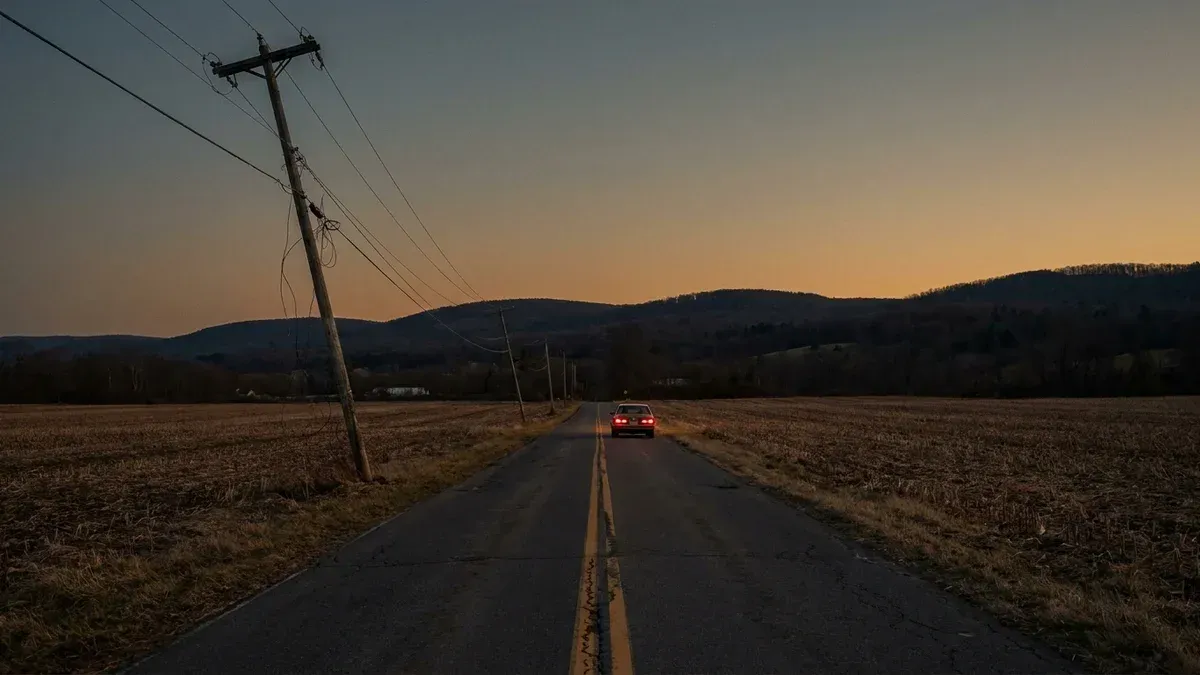
From 2019 to 2023, Genesee County recorded 51 traffic deaths against a population near 58,000, a rate of 88 per 100,000 residents over those five years. Manhattan's five-year rate was 11.5. Genesee's was 7.6 times higher. Thirty counties, nearly all of them rural and upstate, were deadlier per person than any New York City borough, even though the city recorded far more crashes overall.

New York's Own Checkpoint Schedule Gives Away the Real Danger Days
NYPD collision records for 2014 through 2024 show July 3rd and July 5th combined average 166.8 people injured per day, 11.3% above every other day of the year. July 4th itself runs flat, 150.5 injured against a 149.8 baseline. Nationally, July 4th is the single deadliest calendar day on record, 25 years running, and the sharpest local spike inside that window hits at 10pm, not the afternoon. New York's own statewide numbers point past the Fourth too. July 5th ranks worse than July 4th for road deaths over the same 25-year record.