
Crash Data
23 of 30 NYC Cyclist Deaths in 2023 Were E-Bike Riders. Most Were Food-Delivery Workers.
NYC's deadliest year for cyclists in two decades. 2023 delivery pay rule raised wages, not safety. Adams' April 2026 e-bike crackdown shifts cost to riders.

Key Finding
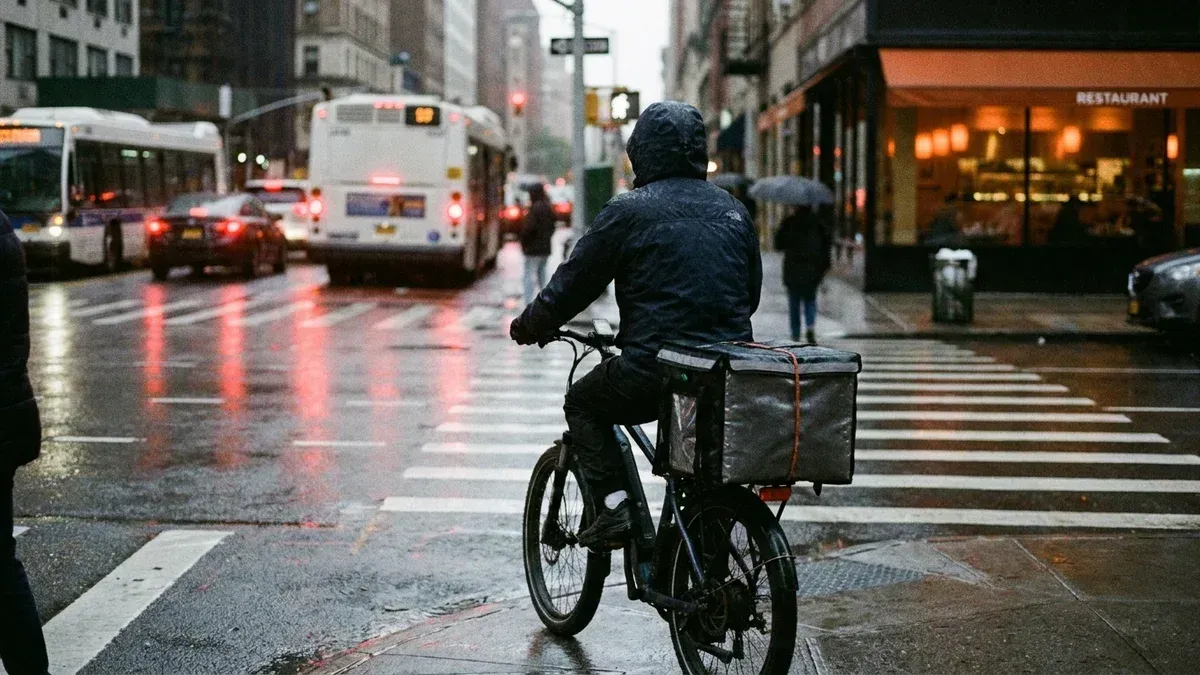
Of 30 cyclist deaths in NYC in 2023, 23 involved e-bike riders, NYC's deadliest cyclist year since 1999. Most were food-delivery workers riding for DoorDash, Grubhub, Uber Eats, Relay, and smaller platforms. The delivery-worker minimum-pay rule (Local Law 115 of 2021, set by DCWP) raised wages, launching at $17.96 per hour in 2023 and reaching $19.96 by April 2025, but did not require platforms to fund safety equipment, certified e-bikes, or rider training. Mayor Adams' April 2026 e-bike enforcement crackdown shifts cost back onto riders without addressing the platform-side incentives that drive risk.
The fastest way to find a delivery rider is to walk down Sixth Avenue between dinner and 10 p.m. The fastest way to find a delivery worker’s family in our intake list is to ask which platform the rider was working for the night a turning truck or a side-door car door took everything.
In 2023, NYC DOT recorded 30 cyclist fatalities. Twenty-three of the dead were e-bike riders. Most of those twenty-three were working for DoorDash, Grubhub, Uber Eats, Relay, or one of the dozens of smaller platforms that own NYC’s last-mile food economy.
Note
Update, July 2026: the new NYC e-bike injury ledger confirms the work-clock pattern in the crash data itself: e-bike injury crashes peak from 4 PM to 6 PM, the heart of the delivery window, and riders absorb most of the harm.
77%
of NYC's 30 cyclist deaths in 2023 were e-bike riders. The deadliest cyclist year since 1999. Most were food-delivery workers.
The 2023 minimum-pay rule fixed pay. It did not fix safety. What follows is the regulatory map, the platforms’ answer (and what’s missing from it), and the legal pathway for families that lost a rider.
The 2023 Numbers
| 2023 NYC Cyclist Fatalities | Count | Share |
|---|---|---|
| Total cyclist deaths | 30 | 100% |
| E-bike rider deaths | 23 | 77% |
| Conventional pedal-bike deaths | 7 | 23% |
Independent reporting from Documented and Los Deliveristas Unidos puts the food-delivery share of the 23 e-bike fatalities at the majority of cases. The platforms do not publish per-rider crash data, so the exact percentage is an inference rather than a counted figure. The platforms’ aggregate safety reports tell a different story than the rider-by-rider intake we and other NYC plaintiff firms see.
The 2024 NYC cyclist fatality count is provisional in the public DOT extracts and is tracking lower than 2023. Total cyclist injuries in 2025 reached an estimated 5,250 across the boroughs.
What the Minimum-Pay Rule Did and Didn’t Do
Local Law 115 of 2021 directed DCWP to set a minimum pay rate for app-based delivery workers in NYC, codified at NYC Administrative Code § 20-1522. The rate launched at $17.96 per hour in July 2023 and reached $19.96 by April 2025, with an inflation adjustment on top. The rule was administered by the NYC Department of Consumer and Worker Protection (DCWP) and survived a court challenge from the platforms.
Note
The rule set wages. Platforms must pay a per-hour or per-trip minimum, absorb the cost rather than pass it through as a transparent consumer fee, and open their pay records to DCWP audit.
The rule did not set safety. It does not require platforms to fund safety equipment, certified e-bikes, helmets, or rider training. It does not change the trip-acceptance deadline structure that pushes riders to ride faster. It does not create platform-side safety reporting. It does not cap ride density per shift.
The omissions were not accidental. The rule was a wage rule. The safety rule that was supposed to follow has not landed.
Mayor Adams’ April 2026 Enforcement Push
Mayor Adams’ April 2026 e-bike enforcement crackdown moved the cost of compliance back onto individual riders. The framework relied on three tools: ticketing for sidewalk riding and other moving violations, equipment seizures of non-compliant e-bikes, and stepped-up NYPD patrol on key delivery corridors.
The math for a rider is simple. A ticket plus an equipment seizure can easily exceed a full shift’s pay. The cost of replacing a seized e-bike, particularly one purchased on an installment plan, can exceed a week’s pay. Platforms, by contrast, face no comparable enforcement cost. A driver who loses access to the app for a day continues to be replaced by another driver.
Los Deliveristas Unidos and Worker’s Justice Project have been organizing around three asks: platform-funded safety gear, certified-only e-bike fleet rules with platform liability for non-compliant equipment they dispatch riders to use, and a per-trip safety surcharge similar to the per-trip wage surcharge under the minimum-pay rule. The NYC Council Committee on Consumer and Worker Protection is the policy venue.
Lithium-Ion Fires and the Local Law 39/40 Gap
FDNY data shows e-bike-related lithium-ion battery fires accounted for a meaningful share of NYC fire fatalities through 2023. Local Law 39 of 2023 banned the sale and assembly of e-bike batteries that don’t meet UL 2271 or UL 2849 certification. Local Law 40 of 2023 banned modified e-bikes.
The compliance picture in the for-hire delivery fleet is uneven. Riders, not platforms, generally own the equipment, which means a non-compliant battery sits in the rider’s apartment until it’s seized or burns. Platform-side fleet certification rules would close the gap. They have not been enacted.
For families of a rider who died in a battery fire rather than a crash, the legal path runs through product liability against the battery manufacturer, the assembler, and the retailer, with parallel claims against the landlord on premises theories where the storage conditions contributed.
The Liability Map
Most fatal delivery-rider cases pass through three layers of recovery.
The at-fault driver’s auto insurance. New York’s no-fault system pays up to $50,000 in PIP regardless of fault. To recover pain and suffering damages on top of no-fault, the family must meet the serious injury threshold under Insurance Law § 5102(d). For fatalities, death itself satisfies the threshold.
The platform. The hardest layer. App-platform riders are typically classified as independent contractors under both the minimum-pay rule and the platforms’ contractor agreements. That classification limits Workers’ Compensation eligibility and creates contractual barriers to direct-employer claims. Where a family can show the platform’s algorithmic dispatch created or contributed to the unsafe condition (excessive ride density, time-pressure prompts, dispatch through dangerous corridors), a negligent-deployment theory can survive a motion to dismiss. Each appellate decision tests where the platform’s duty starts and stops.
The equipment. Where a battery fire, a brake failure, or a structural defect in the e-bike contributed, product liability claims run against the manufacturer, the importer, and the retailer.
The wrongful-death statute, EPTL § 5-4.1 , controls the substantive recovery rules. New York is one of the few states that bars families from recovering grief damages in wrongful-death cases. The Grieving Families Act would change that. Governor Hochul has vetoed the bill four years running.
What Families of a Killed Delivery Rider Should Do
Three steps preserve a claim.
Get the platform’s trip log. The trip-by-trip data the platform maintains, including dispatch timestamps, route, and any in-app prompts, decides whether the platform’s algorithmic dispatch is a viable claim layer. Platforms purge older data on rolling schedules. The first 30 days are the cleanest extraction window.
Document the equipment. The e-bike itself, the battery, and any charger or storage equipment should be preserved. Battery fires destroy the most useful evidence; photographs and witness statements taken before any cleanup carry the case if the manufacturer is the defendant. For crashes without fire, the bike’s serial number, motor type, and battery type tell the product-liability story.
File the no-fault application within 30 days and the wrongful-death suit within two years. The NF-2 preserves PIP benefits if filed within 30 days. The wrongful-death statute of limitations under EPTL § 5-4.1 is two years from the date of death.
Note
If the crash involved a city or MTA vehicle, a notice of claim is required within 90 days under General Municipal Law § 50-e. Missing that window can forfeit recovery even when fault is clear.
What’s Coming
Two regulatory tracks will shape the next phase of NYC delivery-rider safety.
The first is the platform-side fleet rule. The Council’s Consumer and Worker Protection Committee is drafting language that would require platforms to verify the certification status of any e-bike they dispatch a worker to use, and to fund safety equipment for riders working a meaningful share of their hours through the platform. The platforms’ likely litigation posture mirrors their unsuccessful challenge to the minimum-pay rule.
The second is the wrongful-death damages question. The Grieving Families Act would change the calculus for every NYC fatal-crash family, including delivery-rider families. With a fifth Hochul veto possible in the 2026 session, the political question is whether the bill returns in modified form or stays bottled until a different governor.
For the immediate caseload, the operational reality is unchanged. NYC’s last-mile food economy runs on a fleet that the city cannot fully count, equipment that the platforms do not own, and riders whose protection was, until 2023, an afterthought.
Sources
- NYC DOT. Bicycle Crash Data 2023 Report. https://www.nyc.gov/html/dot/downloads/pdf/bicycle-crash-data-report-2023.pdf
- NYC Rules and DCWP. Minimum Pay for Food Delivery Workers (Local Law 115 of 2021), NYC Admin Code § 20-1522. https://rules.cityofnewyork.us/rule/minimum-pay-for-food-delivery-workers-updated/
- NYC Council Legistar. Local Law 39 of 2023 (Lithium-Ion Battery Certification); Local Law 40 of 2023 (Modified E-Bikes). https://legistar.council.nyc.gov/LegislationDetail.aspx?ID=5778201&GUID=39A1F47A-C9D6-444F-A0DC-50CB7B6BB02A
- FDNY. Lithium-Ion Battery Safety. https://www.nyc.gov/site/fdny/codes/reference/lithium-ion-battery-safety.page
- Worker's Justice Project. Los Deliveristas Unidos. https://www.workersjustice.org/en/ldu
- NY Senate. EPTL § 5-4.1; Insurance Law § 5102(d); General Municipal Law § 50-e. https://www.nysenate.gov/legislation/laws/EPT/5-4.1
Updated July 2, 2026
Frequently asked questions
- How many food-delivery workers died on NYC streets in 2023?
Of the 30 cyclist deaths in NYC in 2023, 23 were e-bike riders, NYC's deadliest cyclist year since 1999. Independent reporting from Documented and Los Deliveristas Unidos identifies the majority as gig food-delivery workers for DoorDash, Grubhub, Uber Eats, and Relay. The exact share is hard to pin down because delivery apps do not publish per-rider crash data.
- What does NYC's delivery-app minimum-pay rule cover?
Local Law 115 of 2021 directed DCWP to set a minimum pay rate for delivery workers using app platforms in NYC, codified in NYC Administrative Code § 20-1522. The rate launched at $17.96 per hour in July 2023 and reached $19.96 by April 2025 before an inflation adjustment. The rule addressed wages but did not require platforms to fund safety equipment, certified e-bikes, helmets, or rider training. It also did not change the time-pressure structure built into platform algorithms.
- What can families of a food-delivery worker killed in NYC recover?
Wrongful death recovery in New York follows EPTL § 5-4.1 and depends on rider classification. App-platform riders are typically classified as independent contractors, which limits Workers' Compensation eligibility. Surviving families can pursue claims against the at-fault driver's auto insurance, against the platform on negligent-deployment theories where applicable, and against the e-bike or battery manufacturer in product liability where the cause involved equipment failure. The Grieving Families Act, if enacted, would expand recoverable damages.
- Are NYC's lithium-ion battery rules helping?
Local Law 39 of 2023 banned the sale and assembly of e-bike batteries that don't meet UL 2271 or UL 2849 certification. Local Law 40 of 2023 banned modified e-bikes. FDNY data shows lithium-ion fires linked to e-bikes spiked through 2023 and have begun to decline as enforcement and education caught up. Compliance is uneven in the for-hire delivery fleet because riders, not platforms, generally own the equipment.
Injured in NYC? Talk to a Trial Lawyer.
Free consultation. No fee unless we win.
For journalists, researchers, and re-publishers
Use this insight
Cite this insight
Three formats. Click to copy. Use whichever your style guide accepts.
APA AP style BibTeX
Antin, J. S. (2026, May 2). 23 of 30 NYC Cyclist Deaths in 2023 Were E-Bike Riders. Most Were Food-Delivery Workers.. AEE Law Insights. https://aeelaw.com/insights/nyc-food-delivery-worker-deaths/
Contact the data desk
AEE Law editorial desk. Press inquiries answered within one business day.
Contact the data desk
If you were injured in New York and need a lawyer, get Jeff's read on your case.
More from AEE Law Insights

Five Years Later, New York's Traffic Deaths Are Still 18% Above 2019
New York recorded 1,101 traffic deaths in 2024, 17.9% more than the 934 recorded in 2019, the state's pre-pandemic low. Deaths peaked at 1,182 in 2022 and have eased since, but they remain well above where they stood before the pandemic. The decade of steady declines that ran through 2019 has not resumed.

New York's Deadliest Roads Aren't in the City. They're Upstate.
From 2019 to 2023, Genesee County recorded 51 traffic deaths against a population near 58,000, a rate of 88 per 100,000 residents over those five years. Manhattan's five-year rate was 11.5. Genesee's was 7.6 times higher. Thirty counties, nearly all of them rural and upstate, were deadlier per person than any New York City borough, even though the city recorded far more crashes overall.

The NYC E-Bike Injury Ledger: Every Crash, Every Person Hurt
New York's e-bike-involved crashes have injured 17,434 people and killed 133 since 2019, pedestrians and delivery riders alike. This ledger comes from a full review of 2.27 million NYPD collision records, counting e-bike crashes through May 2026. In 2025, eight of the city's 23 cyclist deaths happened in e-bike-involved crashes.