
Legal Trends
NYC Labor Law 240 Cases Drove $1.1B in Construction Payouts in 2024 and 2025
Top NY construction outcomes 2024-2025 totaled more than $1.1B. NYC's median jury award sits 8.3x the national. Tribeca crane: $272.5M. Trial data.

Key Finding
The top 15 New York personal injury outcomes in 2024 and 2025 totaled more than $1.1 billion. Construction cases dominated the top tier because of New York's Labor Law 240, which imposes absolute liability on owners and contractors for gravity-related injuries. The $272.5 million Tribeca crane collapse settlement is the largest known crane-collapse recovery in New York history. A separate $53.5 million Brooklyn construction-fall verdict, returned in 2023, shows the same Labor Law 240 pattern at trial. The median NY personal injury jury award is $287,628, roughly 8.3 times the national median. New York's strict liability framework is the load-bearing reason the numbers climb.
Key Facts
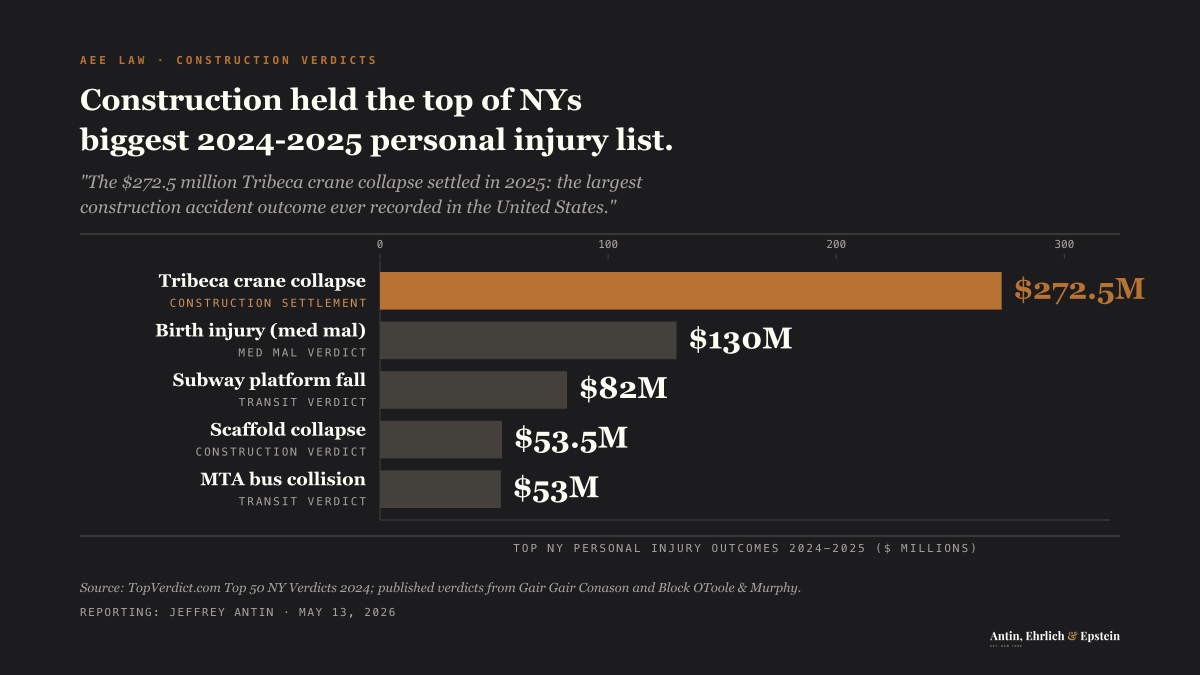
Top 15 New York personal injury outcomes in 2024-2025 totaled more than $1.1 billion. Construction held the top of the list.
The 2016 Tribeca crane collapse settled in 2025 at $272.5 million, the largest known crane-collapse recovery in New York history.
The median NY personal injury jury award is $287,628, roughly 8.3 times the national median. Labor Law 240 is the load-bearing reason.
Labor Law 240 imposes absolute liability on owners and contractors for gravity-related construction injuries. No other state has a comparable statute.
The top 15 New York personal injury outcomes across 2024 and 2025 totaled more than $1.1 billion. Construction cases held the top of that list. A $272.5 million settlement closed the 2016 Tribeca crane collapse in 2025, the largest known crane-collapse recovery in New York history. A separate $53.5 million Brooklyn construction-fall verdict, returned in 2023, shows the same Labor Law 240 pattern at trial.
$272.5M
Tribeca crane collapse settlement, 2025: the largest known crane-collapse recovery in New York history. The top 15 NY personal injury outcomes in 2024-2025 totaled more than $1.1 billion.
Methodology
The outcomes here come from published verdict and settlement reports from Gair Gair Conason Rubinowitz Bloom Hershenhorn Steigman Mackauf, Block O’Toole & Murphy, TopVerdict.com, and Expert Institute. The sample frame is publicly reported NY personal injury verdicts and settlements resolved in calendar years 2024 and 2025 with a disclosed dollar amount. The $272.5 million Tribeca crane settlement, which resolved in 2025, traces to Gair Gair. The $53.5 million Brooklyn construction-fall verdict sits outside that 2024-2025 window: a Kings County jury returned it in 2023, and it appears here as a representative Labor Law 240 trial outcome, not as a member of the 2024-2025 sample. It traces to Block O’Toole.
The median NY jury award figure of $287,628, the national median of $34,550, and the 8.3x ratio come from Jury Verdict Research compensatory-damages data as compiled in industry verdict reporting. Construction outcomes are flagged where the case was filed under Labor Law § 240(1) , Labor Law § 241(6) , or Labor Law § 200.
Note
Confidential settlements are excluded because their amounts are not public. The reported figures therefore understate true plaintiff recoveries in the 2024 to 2025 window, particularly for cases that settled before trial under NDAs.
Construction Owned the Top of the List
Of the top 15 NY personal injury outcomes in 2024 and 2025, multiple were construction cases. The Tribeca crane settlement led that group. The 2023 Brooklyn construction-fall verdict below sits outside the 2024-2025 window but shows the same Labor Law 240 pattern at trial:
$272.5M
Settlement: Tribeca Crane Collapse, 2025
The 2016 Worth Street crane collapse in Manhattan. Wrongful death and multiple severe injuries. The largest known crane-collapse recovery in New York history.
Theory: Multi-defendant construction site liability
Reported New York case, not a case this firm handled.
$53.5M
Jury Verdict: Brooklyn Construction Fall, 2023
A worker fell while hoisting an air conditioning unit at a Brooklyn construction site in 2017 and was paralyzed from the waist down. A Kings County jury returned the verdict in 2023, outside the 2024-2025 sample frame.
Theory: Labor Law 240(1) absolute liability
Reported New York case, not a case this firm handled.
Other top 2024-2025 outcomes were transit (an $81.7 million subway platform verdict in 2025, a $53 million MTA bus collision verdict in 2025) and medical malpractice(a $60 million epidural verdict in 2025).
Across the construction subset, the through-line is Labor Law § 240. The statute imposes absolute liability when a worker is injured in a gravity-related accident: falls from heights, falling objects, scaffold collapses, ladder failures. The owner and general contractor cannot defend by arguing the worker was careless. Comparative negligence does not apply. Once the safety device failed, liability is established. The jury’s only question is damages.
Scaffold Law removes the comparative-negligence defense. Once the device failed, the jury is only deciding how much.
The Median Is 8.3 Times the National
The median NY personal injury jury award is $287,628. The national median sits at $34,550. NY’s median runs 8.3 times higher.
Three structural reasons drive that gap:
No comparative-negligence defense on the gravity cases. Labor Law 240 takes the worker’s conduct off the table on the threshold liability question. The Iowa or Texas equivalent of a Tribeca crane collapse would let the defense argue the worker should have worn a harness, should have inspected the rigging, should have refused the assignment. New York closes those arguments before they reach the jury.
No statutory cap on non-economic damages. Most states cap pain and suffering at a fixed dollar amount or a multiple of economic damages. New York does not. When a construction worker loses both legs in a scaffold fall, the jury can value future pain and suffering at whatever the evidence supports.
NYC juries draw from the highest cost basis in the country. Lost wages, medical care, future life-care plans all calculate against numbers that are higher in New York than anywhere else. Even before the multiplier from non-economic damages, the economic damages baseline is larger.
Trial Versus Settlement
Most NY Labor Law 240 cases never reach a jury. The cases that do, settle differently. Defendants who go to trial in NYC Supreme Court on a 240 case face strict-liability instructions and a jury pool drawn from the five boroughs. The cases that resolve before trial typically settle at a discount to the expected trial outcome. The $272.5 million Tribeca crane number is a settlement, but it resolved on the eve of trial after years of litigation.
The trial-versus-settlement data we have today is publicly available only for cases that proceed to verdict, where the OCA reports the result, or where settlement amounts are filed on the docket. Confidential settlements, which represent the majority of resolved 240 cases, do not surface in public verdict reporting. A complete trial-versus-settlement median for NYC Labor Law 240 cases would require docket-by-docket pulls from the New York State Unified Court System OCA verdict and settlement reports, joined to disposition codes. That harvest is the next data move on this beat.
What’s clear from the published verdict data alone: the cases that reach trial on a strong Labor Law 240 record produce outcomes in the eight-figure range routinely. The $53.5 million construction-fall verdict is one. The $272.5 million Tribeca crane settlement, while resolved before final verdict, was negotiated against years of litigation exposure.
What This Means for NYC Construction Workers
If you were hurt in a gravity-related construction accident in NYC, three points the data above changes:
The legal framework is unique to New York. Labor Law § 240(1) exists nowhere else. A scaffold collapse in NYC and a scaffold collapse in any other state produce different cases. The NY case has absolute liability on the owner and general contractor. The other state’s case requires proving negligence.
The damages ceiling is the injury, not a statute. Because New York does not cap non-economic damages, the value of a Labor Law 240 case scales with the severity of harm. Permanent paralysis, amputations, severe traumatic brain injury, and wrongful death all support seven-, eight-, and nine-figure outcomes when the liability framework holds.
Settlement does not mean low value. The $272.5 million Tribeca crane outcome is a settlement, not a verdict. Owners and insurers settle Labor Law 240 cases at trial-equivalent values when the liability picture is clear and trial would expose them further.
Scaffold Law works when a case is built for trial.
Sources
- TopVerdict. (2024). Top 50 New York Verdicts 2024 and Top 20 NY Personal Injury Settlements 2024. https://topverdict.com/lists/2024/new-york/top-50-verdicts
- Gair Gair Conason Rubinowitz Bloom Hershenhorn Steigman Mackauf. (2025). Notable Verdicts and Settlements Obtained by Our New York Personal Injury Attorneys. https://www.gairgair.com/notable-verdicts-and-settlement-obtained-by-our-personal-injury.html
- Block O'Toole and Murphy. (2025). Verdicts and Settlements. https://www.blockotoole.com/verdicts-settlements/
- Expert Institute. (2025). The Biggest Personal Injury Verdicts and Settlements of 2025. https://www.expertinstitute.com/resources/insights/top-personal-injury-payouts/
- NYCOSH. (2025). Deadly Skyline: Annual Report on Construction Fatalities in New York State, 2025. https://nycosh.org/wp-content/uploads/2026/01/NYCOSH-Deadly-Skyline-Report-2025-1.pdf
- Lawsuit Information Center. (2025). New York Jury Awards and Settlement Statistics (Jury Verdict Research compensatory-damages medians). https://www.lawsuit-information-center.com/new_york_jury_awards.html
- NY State Senate. Labor Law § 240, Scaffolding and Other Devices for Use of Employees. https://www.nysenate.gov/legislation/laws/LAB/240
Updated June 14, 2026
Frequently asked questions
- How much did Labor Law 240 construction cases pay out in NY in 2024 and 2025?
The top 15 personal injury outcomes in New York across 2024 and 2025 totaled more than $1.1 billion. Construction cases held the top of that list. The $272.5 million Tribeca crane collapse settlement, which resolved in 2025, was the largest known crane-collapse recovery in New York history. A separate $53.5 million Brooklyn construction-fall verdict, returned in 2023, shows the same Labor Law 240 pattern at trial.
- What is Labor Law 240?
Labor Law 240, known as the Scaffold Law, imposes absolute liability on property owners and general contractors when a worker is injured in a gravity-related construction accident. Falls from heights, falling objects, scaffold collapses, and ladder failures fall under it. Absolute liability means the owner and contractor cannot defend by arguing the worker was careless. Comparative negligence does not apply.
- Why are NY construction verdicts so high?
Three reasons drive the size of NY construction outcomes. Labor Law 240 removes the comparative negligence defense, which means liability is established once the safety device failed. New York has no statutory cap on non-economic damages, so pain and suffering awards can match the severity of injury. And New York City juries draw from boroughs with the highest cost of living, medical care, and lost wages in the country, which inflates economic damages.
- What is the median NY personal injury jury award?
The median personal injury jury award in New York is $287,628. That is approximately 8.3 times the national median of $34,550. The gap reflects New York's plaintiff-friendly liability framework, uncapped non-economic damages, and the higher cost basis of NYC juries' lived experience.
- What is the Labor Law 240 in NY?
Labor Law § 240, often called the Scaffold Law, requires property owners and general contractors in New York to provide proper protection to workers performing elevation-related tasks, including scaffolds, ladders, hoists, and similar equipment. The statute imposes absolute liability on owners and contractors when a worker is injured by a gravity-related hazard, meaning the injured person doesn't have to prove traditional negligence. New York is the only state that maintains this standard. If a scaffold collapses, a ladder shifts, or an unsecured load falls, the owner and general contractor can be held liable regardless of the worker's own conduct. That liability framework is the load-bearing reason the $272.5 million Tribeca crane settlement and the $53.5 million construction-fall verdict landed where they did.
- What is Section 240(1) of the labor law of the state of New York?
Labor Law § 240(1), commonly called the Scaffold Law, requires owners and general contractors on New York construction sites to provide proper protection against gravity-related hazards, including falls from heights and falling objects striking workers below. The statute imposes absolute liability on covered defendants, meaning an injured construction worker doesn't have to prove negligence in the traditional sense. If the required safety devices were absent or inadequate, liability attaches. New York is the only state that maintains this form of strict liability for elevation-related construction injuries. The Court of Appeals has consistently held that § 240(1) must be construed liberally to accomplish its protective purpose. The specific facts of how the accident occurred decide whether § 240(1) applies.
- What is New York Labor Law 200, 240, and 241?
Labor Law § 200 codifies the common-law duty requiring owners and general contractors to provide a reasonably safe place to work, covering general site conditions and the means and methods of construction. Labor Law § 240 imposes absolute liability on owners and contractors for gravity-related hazards such as falls from unsecured ladders or being struck by falling objects, and it applies regardless of the worker's own conduct. Labor Law § 241(6) requires owners and contractors to comply with specific safety regulations in the New York Industrial Code, and a violation supports a negligence claim even when the owner had no direct control over the work. Together these three statutes form the backbone of NYC construction injury litigation, where § 240 cases account for a disproportionate share of the largest construction verdicts each year. CPLR § 214(5) generally limits filing to three years from the injury, though claims against a municipal or public-authority defendant such as the City or the MTA carry a 90-day notice of claim requirement under General Municipal Law § 50-e and a shorter one-year-and-90-day filing window.
- How much do I pay for a New York construction accident lawyer?
Most New York construction accident attorneys, including AEE Law, handle these cases on a contingency basis. The injured worker pays no attorney's fees unless the case results in a recovery. The contingency percentage is set by written agreement before representation begins and is calculated as a portion of the net recovery after litigation costs are deducted. Under New York court rules, fee agreements have to be in writing and have to explain how costs such as filing fees, expert witness fees, and deposition expenses are handled. The contingency model is designed so that a hurt construction worker can pursue a Labor Law § 240, § 241, or § 200 claim without paying anything out of pocket to get started.
Injured in NYC? Talk to a Trial Lawyer.
Free consultation. No fee unless we win.
For journalists, researchers, and re-publishers
Use this insight
Cite this insight
Three formats. Click to copy. Use whichever your style guide accepts.
APA AP style BibTeX
Antin, J. S. (2026, May 13). NYC Labor Law 240 Cases Drove $1.1B in Construction Payouts in 2024 and 2025. AEE Law Insights. https://aeelaw.com/insights/nyc-labor-law-240-verdict-pattern/
Contact the data desk
AEE Law editorial desk. Press inquiries answered within one business day.
Contact the data desk
If you were injured in New York and need a lawyer, get Jeff's read on your case.
More from AEE Law Insights
Five Years Later, New York's Traffic Deaths Are Still 18% Above 2019
New York recorded 1,101 traffic deaths in 2024, 17.9% more than the 934 recorded in 2019, the state's pre-pandemic low. Deaths peaked at 1,182 in 2022 and have eased since, but they remain well above where they stood before the pandemic. The decade of steady declines that ran through 2019 has not resumed.

New York's Deadliest Roads Aren't in the City. They're Upstate.
From 2019 to 2023, Genesee County recorded 51 traffic deaths against a population near 58,000, a rate of 88 per 100,000 residents over those five years. Manhattan's five-year rate was 11.5. Genesee's was 7.6 times higher. Thirty counties, nearly all of them rural and upstate, were deadlier per person than any New York City borough, even though the city recorded far more crashes overall.

New York's Own Checkpoint Schedule Gives Away the Real Danger Days
NYPD collision records for 2014 through 2024 show July 3rd and July 5th combined average 166.8 people injured per day, 11.3% above every other day of the year. July 4th itself runs flat, 150.5 injured against a 149.8 baseline. Nationally, July 4th is the single deadliest calendar day on record, 25 years running, and the sharpest local spike inside that window hits at 10pm, not the afternoon. New York's own statewide numbers point past the Fourth too. July 5th ranks worse than July 4th for road deaths over the same 25-year record.