
Legal Trends
You Tripped on a NYC Sidewalk. Who Pays Isn't Who You Think.
Since 2003, the adjacent property owner pays for most sidewalk falls, not the city. The exemptions and the 90-day clock decide who you sue.

Key Finding
Since 2003, NYC property owners bear primary liability for sidewalk defects under Administrative Code 7-210, replacing the city's prior responsibility. One-to-three family owner-occupied homes are exempt. Claims against the city for sidewalks it still maintains (near highways, parks, public buildings) require a Notice of Claim within 90 days and proof of prior written notice.
New York City has more than 12,700 miles of sidewalk, and they aren’t always safe.
In fiscal year 2023, the NYC Comptroller’s Annual Claims Report recorded 2,350 sidewalk personal injury claims filed against the city, and the city paid $53.5 million to settle sidewalk claims that year. Those figures don’t include the far larger number of claims filed against private property owners.
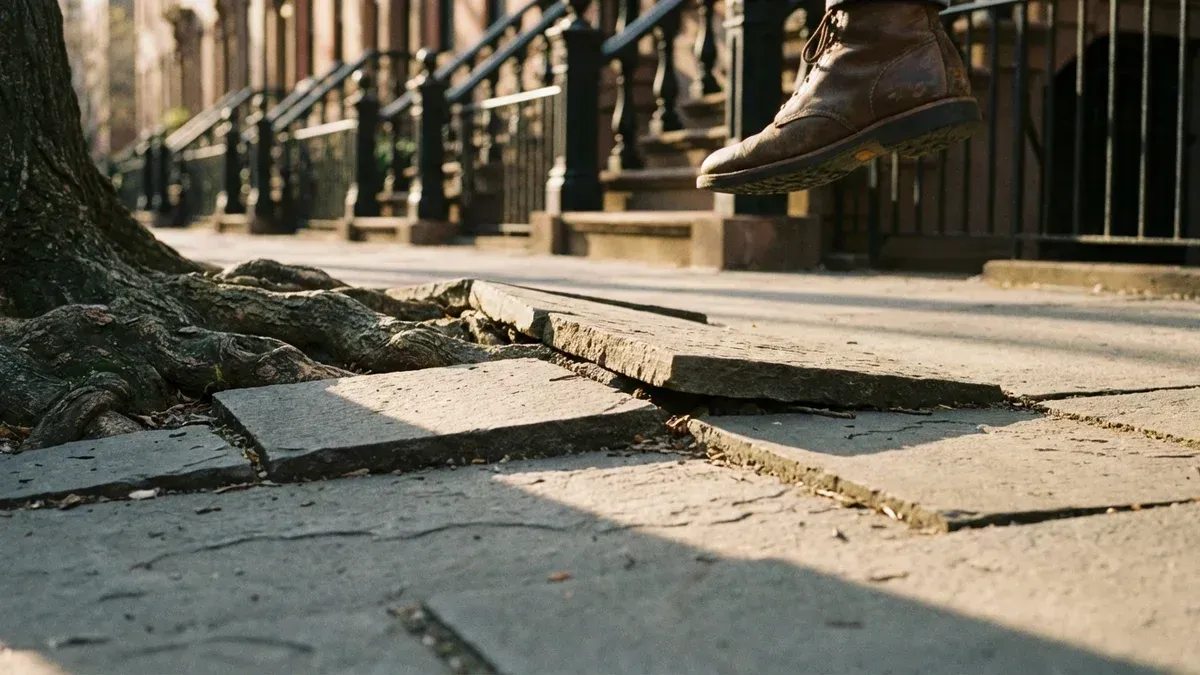
Tree roots heave concrete slabs. Freeze-thaw cycles crack flagstones. Property owners neglect repairs for years. Snow and ice accumulate on uncleared walkways.
2,350
sidewalk personal injury claims filed against NYC in fiscal year 2023. The city paid $53.5 million to settle sidewalk claims that year. Private property owner claims are not included.
When someone trips on a raised sidewalk flag, slips on an icy patch, or falls into an uncovered cellar door, the question is always the same. Who pays?
The answer changed fundamentally in 2003. Here’s how NYC sidewalk liability works, who’s responsible, and what you need to prove.
The 2003 Shift: Administrative Code 7-210
Before September 14, 2003, New York City bore primary responsibility for maintaining sidewalks. If you tripped on a broken sidewalk, your claim was against the city. The city’s defense was almost always the same: prior written notice. If no one had reported the specific defect to the city before your injury, the city walked.
NYC Administrative Code § 7-210 changed everything. The law shifted liability from the city to the property owner adjacent to the sidewalk. Property owners of land abutting a sidewalk are responsible for installing, constructing, repaving, repairing, and replacing the sidewalk, including the curb.
If a person is injured because of a failure to maintain the sidewalk, the property owner is liable.
The practical effect: if you trip on a broken sidewalk in front of a commercial building, an apartment complex, or a multi-family residential property, your claim is against the building owner, not the city.
Who Is Liable Under 7-210
Property Owners (Liable)
The following property owners bear sidewalk liability:
- Commercial property owners. Stores, restaurants, office buildings, warehouses. The adjacent sidewalk is their responsibility.
- Multi-family residential buildings (4+ units). Apartment buildings, co-ops, and condominiums with four or more units.
- Mixed-use buildings. Any building with a commercial component.
- Vacant lots and construction sites. The owner of the underlying property remains liable for the adjacent sidewalk.
The liability is non-delegable. In Xiang Fu He v. Troon Management, Inc. (2019), the New York Court of Appeals unanimously held NYC Administrative Code § 7-210 imposes a non-delegable duty. A property owner can’t escape responsibility by hiring a management company or a snow removal contractor.
If the contractor fails to clear ice and someone falls, the property owner is still liable. The owner can seek reimbursement from the contractor. But the injured person sues the owner.
Owner-Occupied Homes (Exempt)
One-to-three family residential properties that are owner-occupied and used exclusively for residential purposes are exempt from 7-210. If you trip on the sidewalk in front of a single-family house where the owner lives, the city retains liability under the prior written notice framework.
The exemption exists because the city council determined it would be unfair to impose absolute sidewalk liability on individual homeowners. The result: homeowners still have a moral obligation to maintain their sidewalks. But a legal claim against them requires proving negligence, not the strict liability standard that applies to commercial and multi-family property owners.
The City (Limited Liability)
The city retains direct responsibility for sidewalks it controls:
- Sidewalks adjacent to city-owned property (public buildings, fire stations, police precincts)
- Sidewalks in and around public parks (NYC Parks Department)
- Sidewalks along highways and overpasses (NYC DOT)
- Sidewalks where the city created the defect (utility work, road construction)
- Sidewalks where the city made a “special use” (installing infrastructure, bus shelters, bike racks)
Claims against the city for these sidewalks require a Notice of Claim within 90 days under General Municipal Law § 50-e. They also require proof the city had prior written notice of the defect.
Prior Written Notice: The City’s Shield
When the city is the defendant, the prior written notice doctrine is the most common defense. To hold the city liable, you must prove one of the following:
Someone reported the specific defect to the city before your injury. A 311 complaint, a DOT sidewalk repair request, a community board notification, or a letter to the borough commissioner’s office. The notice must identify the specific location and the specific condition.
The city created the defect. If a city construction crew broke the sidewalk during utility work and failed to repair it, prior written notice isn’t required. The city created the hazard and is liable.
The city made a special use of the sidewalk. Installing a tree pit, a bus shelter foundation, or other infrastructure that altered the sidewalk’s condition creates liability without prior written notice.
The prior written notice requirement has been criticized as an unfair barrier. The city maintains over 12,700 miles of sidewalk. Defects are everywhere. But unless someone formally reported the specific broken slab or raised flag before the injury, the city walks away.
NYC DOT inspects sidewalks on a rotating basis. Property owners receive violation notices for defects. Those DOT inspection records can sometimes serve as evidence of prior written notice.
Snow and Ice: Administrative Code 16-123
Snow and ice removal is governed by a separate provision. NYC Administrative Code § 16-123 requires property owners (including owner-occupied homes) to clear snow, ice, and dirt from the sidewalk within a specified time after a snowfall ends:
- Residential properties: Snow must be cleared within 4 hours after the snow stops, or by 11:00 AM if the snow stopped between 9:00 PM and 7:00 AM.
- Commercial properties: Same timeframe. The clearing duty applies to commercial owners on the same schedule.
- Width: A path at least 4 feet wide must be cleared. At bus stops, the full bus stop area must be cleared.
Failure to clear snow and ice within these timeframes creates liability for any injuries that result. The injured person must prove the property owner had a reasonable opportunity to clear the snow or ice before the fall.
Storm-in-progress doctrine: property owners aren’t generally liable for injuries that occur during an active storm. The obligation to clear begins after the storm ends. Once the storm ends, the clock starts running.
Common Sidewalk Defects
The defects that produce the most injury claims in NYC:
Raised sidewalk flags
Tree roots are the primary cause. As street trees grow, their root systems can exert up to 1,000 pounds per square inch, pushing concrete slabs upward.
A height differential of as little as half an inch constitutes a defect under NYC DOT standards. NYC Parks receives over 9,000 requests per year for sidewalk inspections related to tree damage.
Broken or crumbling concrete
Age, weather, and heavy vehicle traffic (delivery trucks driving onto sidewalks) deteriorate concrete over time. Chunks break off, holes form, and the surface becomes uneven.
Missing or broken cellar doors
Many NYC buildings have cellar access through sidewalk-level doors. When the doors are left open, improperly secured, or deteriorated, they create fall hazards. Cellar door injuries can be severe because the fall is into a below-grade space.
Metal grates and utility covers
Con Edison access panels, subway grates, and water main covers can become slippery when wet. They can shift under foot traffic or develop gaps between the cover and the surrounding concrete.
Construction debris and scaffolding
Active construction sites create temporary sidewalk hazards: uneven plywood walkways, mud, debris, and reduced visibility under scaffolding. The general contractor and property owner share liability for pedestrian safety during construction.
What This Means for Injured Pedestrians
If you were injured on a NYC sidewalk, the first question is who owned the adjacent property. That determines who you sue and what you need to prove.
Private property owner (commercial or 4+ unit residential)
File a personal injury lawsuit within 3 years. Prove the sidewalk was defective and the owner failed to maintain it. You don’t need to prove prior notice under 7-210. Liability is effectively strict. The owner had a duty to maintain the sidewalk, the sidewalk was defective, and you were injured.
Owner-occupied 1-3 family home
The city retains liability. File a Notice of Claim within 90 days. Prove prior written notice of the defect.
City-maintained sidewalk
File a Notice of Claim within 90 days under General Municipal Law § 50-e. Prove the city had prior written notice, or that the city created the defect or made a special use.
Snow and ice
Determine whether the storm-in-progress doctrine applies. If the storm had ended and the property owner had a reasonable opportunity to clear the sidewalk, liability attaches.
Document the defect immediately. Photographs of the specific condition that caused the fall, the location, the surrounding area, and your injuries. NYC sidewalks change. Construction crews repair defects. Property owners pour new concrete. The evidence can disappear within days.
We’ve handled slip and fall cases across all five boroughs for over 37 years. We know how to identify the responsible property owner, obtain city inspection records, and prove the defect existed before the injury.
Call 212-221-5999 or request a free case review.
Sources
- NYC. Administrative Code § 7-210: Liability of Real Property Owners for Failure to Maintain Sidewalks. https://codelibrary.amlegal.com/codes/newyorkcity/latest/NYCadmin/0-0-0-4164
- NYC. Administrative Code § 16-123: Removal of Snow, Ice and Dirt from Sidewalks. https://codelibrary.amlegal.com/codes/newyorkcity/latest/NYCadmin/0-0-0-26213
- NY Senate. General Municipal Law § 50-e: Notice of Claim. https://www.nysenate.gov/legislation/laws/GMU/50-E
- NYC Comptroller. (2024). Annual Claims Report, FY2023. https://comptroller.nyc.gov/reports/annual-claims-report/
- NYC DOT. (2024). Sidewalk Inspection and Repair Program. https://www.nyc.gov/html/dot/html/infrastructure/sidewalks.shtml
Updated July 12, 2026
Frequently asked questions
- Who is responsible for sidewalk injuries in New York City?
Since 2003, property owners adjacent to the sidewalk are primarily responsible for maintaining the sidewalk in safe condition under NYC Administrative Code 7-210. This includes commercial landlords, residential building owners, and co-ops/condos. The major exception is one-to-three family owner-occupied homes, which are exempt from the law. The city retains responsibility for sidewalks adjacent to city-owned property, parks, highways, and certain public buildings.
- How long do I have to file a sidewalk injury claim in NYC?
If the property owner is a private party, you have 3 years to file a personal injury lawsuit. If the sidewalk is maintained by the city or a government entity, you must file a Notice of Claim within 90 days of the injury. Missing the 90-day deadline for government claims can permanently bar your case. In both situations, you should document the defect and your injuries as soon as possible.
- What is prior written notice for NYC sidewalk claims?
For claims against New York City, you generally must prove the city had prior written notice of the specific sidewalk defect before your injury. This means someone previously reported the defect to the city (via 311, DOT complaint, or community board request) and the city failed to repair it. Without prior written notice, the city is typically immune from liability. Exceptions exist when the city created the defect or made a special use of the sidewalk.
- What is the slip-and-fall law in NYC?
Since 2003, NYC Administrative Code § 7-210 has placed primary responsibility for sidewalk maintenance on the property owner adjacent to the sidewalk. Commercial owners, multi-family buildings of four or more units, and mixed-use buildings are strictly liable for injuries caused by defective sidewalks they failed to maintain. One-to-three family owner-occupied homes are exempt, and the City retains liability for sidewalks at parks, highways, and city-owned property. Snow and ice removal is governed separately by Admin Code § 16-123, with a four-hour clearing window after a storm ends for residential properties. Claims against the City require a Notice of Claim within 90 days under GML § 50-e.
- What is the average payout for a sidewalk slip and fall in New York City?
There's no single average. The NYC Comptroller's FY2023 Annual Claims Report logged 2,350 sidewalk personal injury claims filed against the City, and the City paid $53.5 million to settle sidewalk claims that year. Claims filed and claims settled are different pools, so dividing one by the other doesn't produce a meaningful per-claim figure. Those numbers also cover only City-paid claims and exclude the far larger volume filed against private property owners under Administrative Code § 7-210. Individual case values vary widely with injury severity, liability clarity, and available insurance. Comparative negligence under CPLR Article 14-A applies in NY, so a recovery can be reduced by the injured person's own share of fault.
- What are the four elements of negligence in a NY premises case?
Duty, breach, causation, and damages. Duty is the legal obligation the property owner or City owed (for example, the non-delegable sidewalk-maintenance duty under NYC Administrative Code § 7-210). Breach is the failure to meet that duty, like leaving a raised flag or uncleared ice in place. Causation requires showing the defect was a substantial factor in producing the injury. Damages are the measurable losses, medical bills, lost wages, and pain and suffering. Unlike no-fault motor-vehicle cases under Insurance Law § 5102(d), premises cases carry no serious-injury threshold and recover the full range of provable harm, subject to comparative negligence.
Injured in NYC? Talk to a Trial Lawyer.
Free consultation. No fee unless we win.
For journalists, researchers, and re-publishers
Use this insight
Cite this insight
Three formats. Click to copy. Use whichever your style guide accepts.
APA AP style BibTeX
Antin, J. S. (2026, March 24). You Tripped on a NYC Sidewalk. Who Pays Isn't Who You Think.. AEE Law Insights. https://aeelaw.com/insights/nyc-sidewalk-injury-laws/
Contact the data desk
AEE Law editorial desk. Press inquiries answered within one business day.
Contact the data desk
If you were injured in New York and need a lawyer, get Jeff's read on your case.
More from AEE Law Insights

Five Years Later, New York's Traffic Deaths Are Still 18% Above 2019
New York recorded 1,101 traffic deaths in 2024, 17.9% more than the 934 recorded in 2019, the state's pre-pandemic low. Deaths peaked at 1,182 in 2022 and have eased since, but they remain well above where they stood before the pandemic. The decade of steady declines that ran through 2019 has not resumed.

New York's Deadliest Roads Aren't in the City. They're Upstate.
From 2019 to 2023, Genesee County recorded 51 traffic deaths against a population near 58,000, a rate of 88 per 100,000 residents over those five years. Manhattan's five-year rate was 11.5. Genesee's was 7.6 times higher. Thirty counties, nearly all of them rural and upstate, were deadlier per person than any New York City borough, even though the city recorded far more crashes overall.

The NYC E-Bike Injury Ledger: Every Crash, Every Person Hurt
New York's e-bike-involved crashes have injured 17,434 people and killed 133 since 2019, pedestrians and delivery riders alike. This ledger comes from a full review of 2.27 million NYPD collision records, counting e-bike crashes through May 2026. In 2025, eight of the city's 23 cyclist deaths happened in e-bike-involved crashes.